Why SecOps teams are exploring adaptive defenses that shape attacker decisions before compromise escalates. How security teams can disrupt reconnaissance, and reduce attacker certainty.
Executive Summary
Cybersecurity is entering a new phase where defensive advantage may depend less on detecting attackers and more on influencing them. As AI compresses attack timelines and organizations deploy growing numbers of autonomous systems, security architectures built around human investigation and response are coming under increasing pressure. A new generation of deception technologies is emerging to address this shift by moving beyond static decoys toward adaptive systems designed to shape attacker behavior in real time.
This report argues that agentic deception represents more than an incremental evolution of traditional deception technologies. It reflects a broader architectural shift from passive observation toward active environmental influence. Instead of waiting to detect malicious activity after it has begun, agentic deception seeks to manipulate the information, context, and decision-making processes that attackers, whether human or autonomous, rely upon throughout an intrusion. While the category remains in its early stages, it introduces an important question for security leaders: if offensive operations continue to accelerate, should defensive architectures evolve from observing attacks to actively shaping them?
The report examines this emerging category through the lens of Acalvio, one of several vendors exploring adaptive deception across identity, cloud, and AI-enabled environments. Acalvio’s platform serves as a case study for understanding how deception technologies are evolving, where they may offer strategic value, and which questions remain unresolved as the market matures. The premise underlying this category is that in a machine-speed environment, visibility alone arrives too late to change outcomes. If that premise holds, advantage shifts toward organizations that can actively shape what an attacker perceives, not merely observe what an attacker does.
Key Takeaways For Readers
- Agentic deception represents an architectural shift, extending deception from static assets toward adaptive systems that can influence attacker behavior during reconnaissance and early intrusion stages.
- AI changes both sides of the security equation. Organizations must defend not only against autonomous attackers but also protect rapidly expanding AI-enabled enterprise environments.
- Environmental influence is emerging as a complementary security control. Deception should be evaluated alongside detection, response, identity, and runtime protections rather than as a replacement for them.
- The market remains early. While platforms such as Acalvio demonstrate how adaptive deception may evolve, organizations should prioritize measurable operational outcomes, independent validation, and integration with existing security architectures over visionary claims alone.
Thanks for reading Software Analyst Cyber Research! Subscribe for free to receive new cybersecurity reports across SecOps, Identity, Cloud and Data/AI
What Security Leaders Should Do
Security leaders should begin evaluating deception as an architectural capability instead of a niche point product. As part of that evaluation, organizations should:
- Assess whether existing security controls can operate effectively against automated attacks.
- Determine where adaptive deception can complement existing detection, identity, and response capabilities.
- Evaluate how deception platforms integrate across cloud, identity, and AI-enabled environments.
- Request independent evidence of operational effectiveness, including customer deployments, MITRE ATT&CK or ATLAS mappings, and measurable production outcomes.
- Consider deception as one component of a broader strategy for reducing attacker certainty rather than simply increasing defensive visibility.
Why Deception Is Returning
For much of the past decade, deception occupied a relatively specialized place within enterprise security architectures. Honeypots, honeytokens, and decoy systems proved valuable for generating high-confidence alerts and exposing attacker behavior, but they were often deployed selectively, required ongoing maintenance, and rarely became foundational components of security programs. As organizations invested heavily in prevention, detection, and response technologies, deception remained an effective but niche capability.
That context is beginning to change.
Two parallel shifts are reshaping how defenders think about the role of deception. The first is the rapid acceleration of offensive operations through automation and AI. Recent industry reports indicate the time to detect an active breach remains substantial, approximately eight months (241 days) on average, per IBM’s 2025 report, underscoring how wide the gap remains between attacker speed and defender response time. The luxury of time, the days or weeks defenders once used for investigation, has diminished significantly. Machine-speed attacks have compressed the window of opportunity. The 2026 Verizon DBIR further corroborates this trend, as does the graph below. This graph from Zero Day Clock depicts the vast change of pace of vulnerability and exploit weaponization. This is one of the key drivers to moving to new defensive measures. Note: 2026 data reflects partial-year findings as of July 2026.
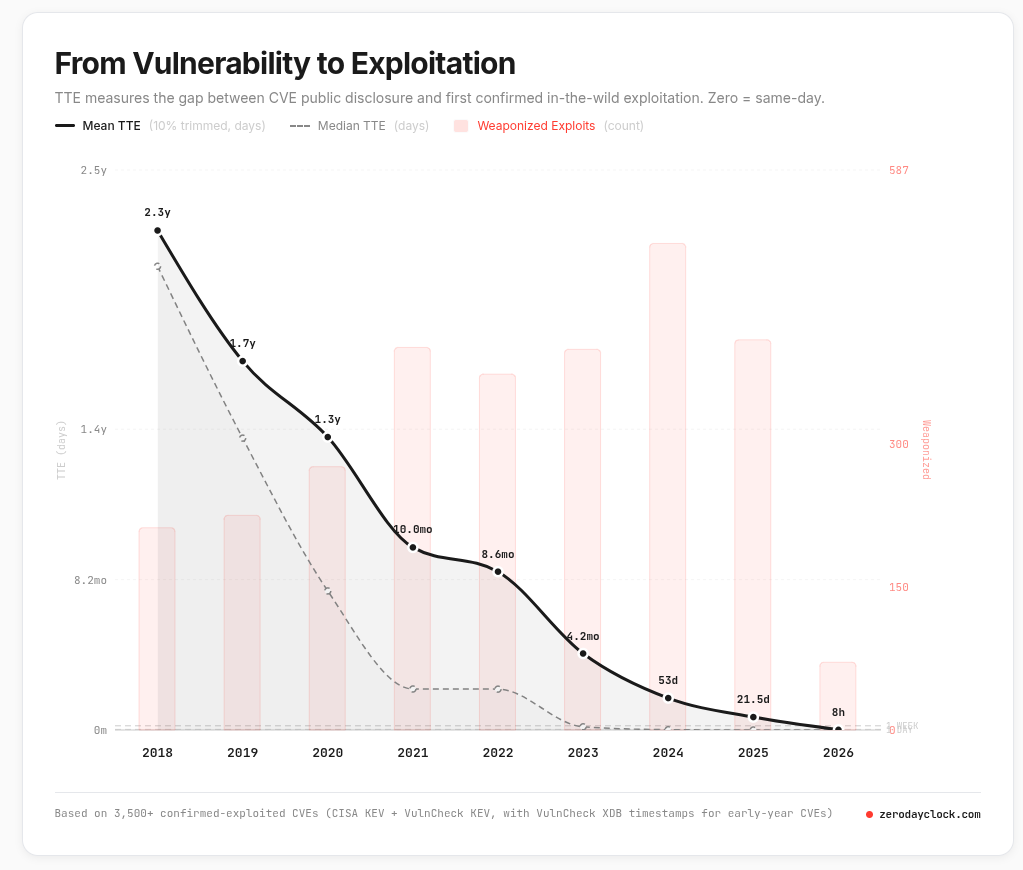
The significance of this trend is not in any specific data point. The significance is the trajectory: a time-to-exploit window that has collapsed from years to hours highlights a future in which portions of the attack lifecycle operate at machine speed. As attack timelines compress, the effectiveness of defensive models built around human investigation and decision-making may come under increasing pressure. This dynamic sits at the center of the broader discussion surrounding adaptive defense, autonomous response, and agentic deception.
The second shift is occurring inside the enterprise itself. Organizations are rapidly deploying AI assistants, autonomous workflows, retrieval-augmented generation (RAG) systems, and Model Context Protocol (MCP) environments to improve productivity and automate business processes. These systems create a fundamentally different attack surface. Instead of exploiting software vulnerabilities alone, adversaries may seek to manipulate prompts, poison context, abuse connected tools, or influence autonomous decision-making. As AI becomes embedded throughout enterprise operations, security teams must consider not only how to protect traditional infrastructure, but also how to protect systems that reason, retrieve information, and act on behalf of users.
Taken together, these trends are changing the assumptions that have guided cybersecurity for decades. Security architectures have historically focused on preventing compromise where possible, detecting malicious activity when prevention fails, and responding before attackers achieve their objectives. That sequence assumes defenders have sufficient time to observe events, investigate them, and coordinate a response. As attack timelines continue to compress, that assumption becomes difficult to sustain.
The New Security Reality
Defenders must now manage a future where three distinct elements coexist:
- Autonomous Attackers: AI systems that can execute exploits at scale.
- Autonomous Enterprise Systems: The AI tools that power our business processes.
- Automated Security Controls: The defense mechanisms attempting to keep pace.
The remainder of this note focuses on the interaction between the first two, and on whether the third category can evolve from passive detection into active environmental influence.
Why Visibility Isn’t Enough
While it remains unclear whether the future of defense lies in deception, autonomous response, or adaptive security, one truth is emerging: Cybersecurity is shifting. In this new world, speed, adaptability, and active decision-making are as critical as visibility.
The core question for future security architecture is simple: Can we build mechanisms that not only detect and respond to threats, but actively influence the environment, data, and decisions that adversaries rely on?
This does not mean detection and response are becoming obsolete. Visibility, investigation, and remediation remain essential components of every mature security program. However, organizations are exploring whether additional controls can operate earlier in the attack lifecycle, reducing attacker confidence and influencing outcomes before a compromise is fully established.
This renewed interest has brought deception technologies back into focus.
Unlike traditional security controls, deception is designed to influence what attackers perceive about an environment. Rather than simply identifying malicious activity after it occurs, deception seeks to shape reconnaissance, redirect adversary behavior, and introduce uncertainty into the information attackers rely upon to make decisions. In an era where both attackers and enterprise systems are becoming more autonomous, that ability to influence the environment may become an valuable complement to detection and response.
Whether adaptive deception ultimately becomes a foundational component of enterprise security remains an open question. The category is still maturing, and many of its architectural claims require broader operational validation. What is becoming clear, however, is that deception is no longer being evaluated solely as a collection of honeypots or decoy credentials. It is increasingly being considered as part of a broader discussion about how defensive architectures must evolve as automation transforms both sides of the cybersecurity equation.
From Honeypots to Agentic Deception
Deception is one of cybersecurity’s oldest defensive concepts. Long before today’s discussions of AI-native security, organizations deployed honeypots, decoy services, and honeytokens to expose attacker activity that would otherwise remain invisible. Their value stemmed from a simple principle: legitimate users should never interact with deceptive assets. When they did, defenders gained a high-confidence signal that malicious reconnaissance or unauthorized access was underway.
Despite these strengths, deception remained a specialized capability for much of the last two decades. Traditional deployments often required careful planning, manual placement, and ongoing maintenance to remain believable as production environments evolved. As cloud adoption accelerated and enterprise infrastructure became dynamic, maintaining realistic deception environments grew more operationally intensive. Many organizations concluded that deception was valuable for targeted use cases, but difficult to operate as a broad architectural control.
Today, several trends are prompting a reassessment of that conclusion.
Enterprise environments have become significantly more distributed across cloud platforms, SaaS applications, identity providers, and hybrid infrastructure. At the same time, attackers have become more reliant on automation to accelerate reconnaissance, privilege discovery, and lateral movement. Instead of manually exploring environments over days or weeks, adversaries can now leverage automation to identify relationships, enumerate identities, and discover attack paths at a pace that challenges traditional investigative workflows.
This convergence changes the requirements for deception itself. Static decoys that are updated periodically may no longer be sufficient in environments that change continuously. In light of this, organizations are asking whether deception can become adaptive, automatically reflecting changes in infrastructure, identities, cloud resources, and AI-enabled workflows without extensive manual intervention.
The evolution of deception can therefore be understood as a progression through several architectural stages.
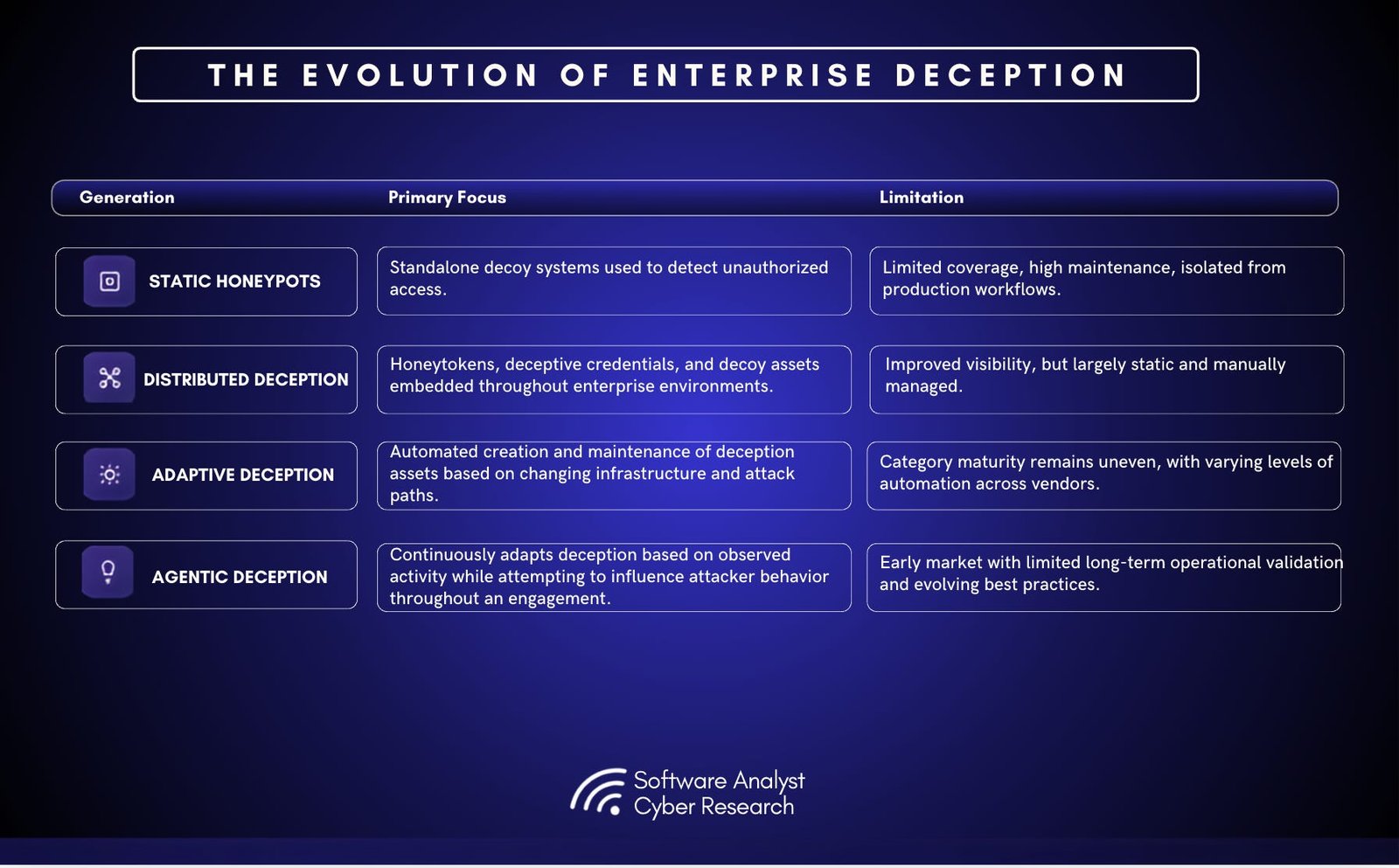
This progression reflects more than incremental product development. It illustrates a broader shift in defensive philosophy. Earlier deception technologies focused primarily on revealing attacker activity. Emerging approaches seek to shape attacker decision-making by manipulating the information available during reconnaissance, credential discovery, and lateral movement.
Importantly, agentic deception should not be viewed as a replacement for existing security controls. Organizations still require prevention, detection, investigation, and response capabilities to manage modern cyber risk. Instead, deception is being evaluated as an additional architectural layer that operates earlier in the attack lifecycle, complementing identity security, endpoint detection and response (EDR), extended detection and response (XDR), and cloud security by influencing attacker behavior before objectives are achieved.
Not every vendor defines this evolution in the same way. Some continue to emphasize high-confidence detection through deception. Others focus on attack path disruption, moving target defense, or identity-centric deception. More recently, several vendors have begun extending deception into AI-enabled environments, including agent frameworks, retrieval systems, and Model Context Protocol (MCP) deployments. While implementation strategies differ, they share a common objective: reducing attacker certainty and increasing the cost of successful reconnaissance.
Viewed through this broader lens, agentic deception is best understood not as a single product category, but as one possible direction in the evolution of adaptive cyber defense. Whether it ultimately becomes a foundational component of enterprise security will depend on its ability to demonstrate measurable operational value at scale.
The market for deception technologies is still undergoing a period of architectural convergence. While vendors use terms such as adaptive, dynamic, or agentic deception, there is no universally accepted definition of these concepts, and implementation maturity varies considerably across the market. Organizations should therefore evaluate vendor claims based on demonstrable operational outcomes rather than terminology alone. The defining characteristic of this emerging category is not the presence of AI, but the extent to which deception can adapt to changing environments, integrate with existing security operations, and measurably influence attacker behavior without introducing prohibitive operational overhead.
Defining the Agentic Deception Category
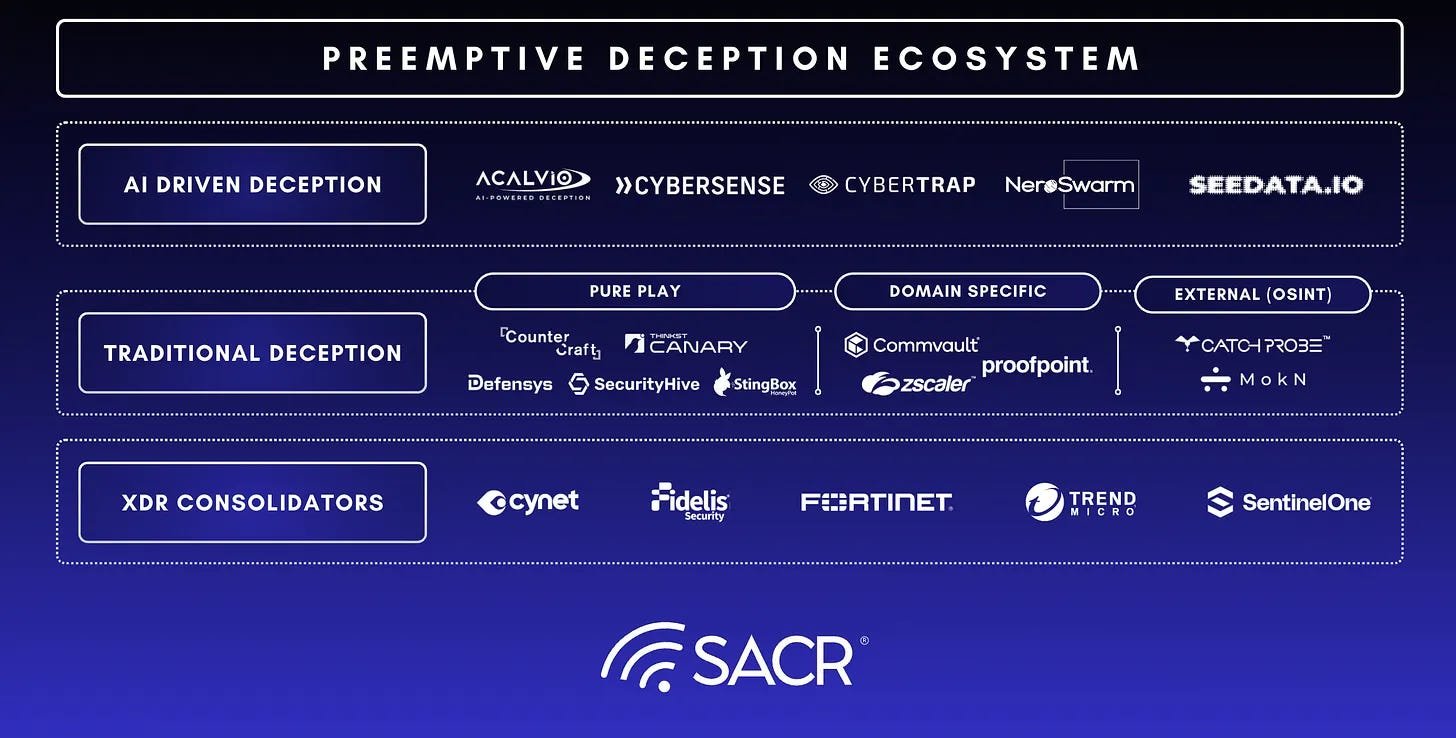
Cybersecurity categories often evolve faster than the language used to describe them. Terms such as AI-native security, adaptive defense, runtime protection, and agentic security are appearing in vendor messaging, yet they frequently describe overlapping capabilities and not clearly defined markets. Deception technologies are experiencing a similar transition. While many vendors now position their platforms as adaptive or autonomous, there is not yet a widely accepted definition of what distinguishes agentic deception from earlier generations of deception technology.
SACR defines agentic deception as:
An adaptive security architecture that continuously modifies deceptive assets, environmental signals, and engagement pathways to influence attacker behavior throughout the attack lifecycle.
Unlike traditional deception technologies, which primarily function as detection mechanisms, agentic deception seeks to shape the attacker’s understanding of the environment itself. Its objective is not simply to identify malicious activity after reconnaissance has begun, but to reduce the accuracy of the information an adversary uses to make decisions. In this model, deception becomes an active participant in the engagement rather than a passive tripwire waiting to be triggered.
This distinction is particularly important as enterprise environments become more dynamic. Cloud infrastructure changes continuously. Identity relationships evolve. AI agents interact with external tools and data sources. In these environments, static deception assets can lose relevance if they fail to reflect operational reality. Agentic deception attempts to address this challenge by continuously adapting deceptive resources and engagement strategies as the environment and attacker behavior change.
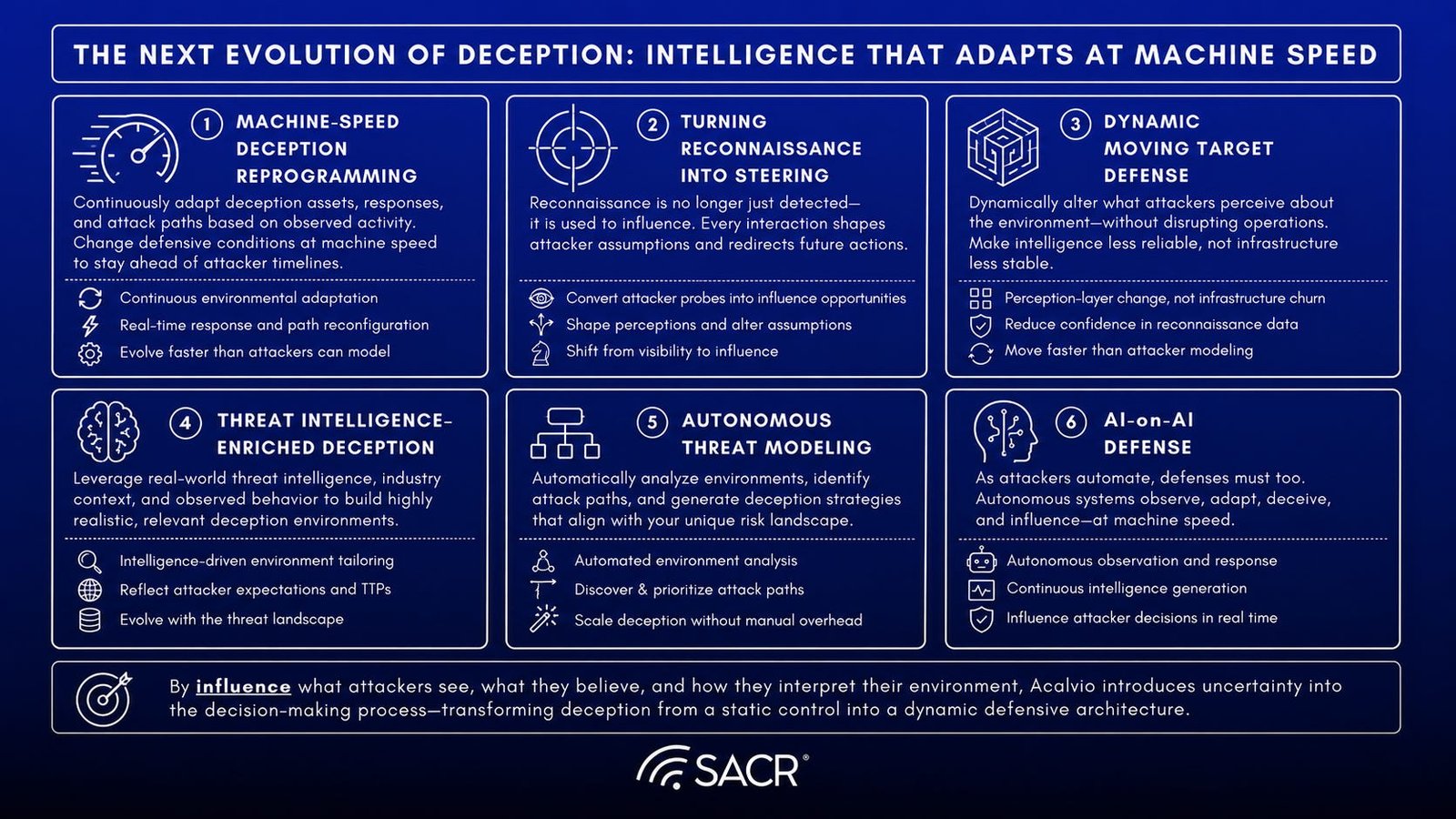
At a conceptual level, agentic deception combines several established security disciplines:
- Deception technology, to create believable but controlled assets that reveal malicious activity.
- Moving target defense, to reduce attacker confidence by limiting the reliability of environmental observations.
- Threat intelligence, to increase the realism and relevance of deceptive environments.
- Automation and AI, to continuously adapt deception without requiring extensive manual administration.
None of these capabilities is entirely new on its own. The architectural shift lies in bringing them together as a coordinated system designed to influence adversary decision-making throughout an engagement rather than performing isolated security functions.
What Agentic Deception Is Not
As the category develops, it is equally important to define what agentic deception does not encompass.
- It is not a replacement for endpoint detection and response (EDR), extended detection and response (XDR), or security information and event management (SIEM). Those platforms remain essential for telemetry collection, investigation, correlation, and incident response.
- It is not security orchestration, automation, and response (SOAR), which focuses on automating defensive workflows after alerts have been generated.
- It is not breach and attack simulation (BAS), whose primary objective is to assess defensive readiness through controlled testing and not just influence live adversary behavior.
Nor should it be viewed as a substitute for identity security, cloud security, or AI runtime protections. Instead, agentic deception is best understood as an architectural layer that complements these capabilities by introducing uncertainty into the reconnaissance and decision-making processes that precede many successful attacks.
Where Agentic Deception Fits
Rather than replacing existing security controls, agentic deception introduces an adaptive layer designed to influence attacker behavior before traditional detection and response processes become necessary.
Why This Matters for Security Leaders
The emergence of agentic deception reflects a broader shift in how security leaders are thinking about defensive architecture. Historically, organizations have measured the effectiveness of security controls by their ability to prevent compromise, detect malicious activity, or accelerate response. Historically, cybersecurity has optimized for visibility. However, visibility alone arrives too late to change outcomes. Adaptive deception introduces a second optimization objective: attacker uncertainty. Security architectures that maximize visibility without affecting attacker confidence will struggle against autonomous adversaries capable of making decisions at machine speed.
Whether this architectural approach ultimately becomes a standard component of enterprise security remains uncertain. The market is still early, terminology continues to evolve, and independent operational validation remains limited. Nevertheless, the underlying concept, influencing attacker behavior and not just simply observing it, represents a meaningful evolution in defensive thinking and provides a useful framework for evaluating the next generation of deception platforms.
SACR Analysis
The defining characteristic of agentic deception is not the use of AI. Many security products now incorporate AI-assisted analytics or automation without fundamentally changing how they influence attacker behavior. What distinguishes this emerging category is the combination of continuous adaptation, environmental awareness, and behavioral influence into a unified defensive architecture.
Organizations evaluating vendor claims should therefore focus less on whether a platform is marketed as agentic and more on whether it demonstrably adapts to changing environments, integrates with existing security operations, and measurably alters attacker outcomes. As with many emerging cybersecurity categories, marketing terminology has evolved faster than common industry definitions. Buyers should evaluate architectural capabilities and operational evidence and not just product labels.
Architectural Principles of Adaptive Deception
As deception technologies evolve beyond static decoys, they are being designed around a different objective. Instead of functioning solely as isolated detection mechanisms, emerging platforms seek to influence how attackers perceive, interpret, and navigate enterprise environments. While implementations vary across vendors, several architectural principles are beginning to define this new generation of adaptive deception.
These principles represent a shift in defensive philosophy rather than a single product architecture. Organizations evaluating deception platforms should consider how effectively vendors operationalize each capability, regardless of whether they use identical terminology.
Environmental Influence, Not Passive Observation
Traditional security architectures are designed to observe malicious activity as accurately and as early as possible. Firewalls block unauthorized access, endpoint agents generate telemetry, and SIEM platforms aggregate evidence for investigation. Each control contributes to understanding what has occurred.
Adaptive deception introduces a complementary objective: influencing what attackers believe about the environment before they achieve their objectives.
Instead of treating reconnaissance as a precursor to compromise, adaptive deception treats it as an opportunity to shape attacker perception. By presenting carefully controlled environmental signals, deceptive credentials, services, identities, or infrastructure, defenders can reduce the reliability of the information attackers depend upon to make decisions.
This does not eliminate the need for detection or response. Instead, it seeks to improve defensive outcomes by reducing attacker certainty earlier in the engagement.
Reconnaissance Becomes a Defensive Opportunity
Reconnaissance has historically favored the attacker. Service banners, Active Directory relationships, cloud metadata, API responses, storage locations, and identity relationships all contribute to an ever more accurate understanding of the target environment. Every successful observation improves the attacker’s ability to prioritize exploitation and lateral movement.
Adaptive deception attempts to invert that advantage, instead of allowing reconnaissance to function solely as an intelligence-gathering activity, deception introduces controlled uncertainty into the process. If attackers cannot reliably distinguish production assets from deceptive ones, the quality of their intelligence begins to degrade. The objective is not to prevent reconnaissance entirely, but to reduce its usefulness.
Every interaction becomes an opportunity to gather intelligence, influence attacker decision-making, and improve future defensive responses.
Adaptation Becomes More Important Than Static Coverage
One of the historical limitations of deception has been operational maintenance. Static deception environments often require administrators to manually deploy and update decoys as infrastructure changes. In modern enterprises, where cloud resources, identities, workloads, and AI services evolve continuously, manually maintaining believable deception assets becomes yet more difficult.
Adaptive deception seeks to address this challenge by automating portions of the deception lifecycle. Rather than relying on periodically refreshed assets, platforms attempt to adjust deception in response to environmental changes, infrastructure updates, or observed attacker behavior. The degree of automation varies significantly across vendors, but the underlying objective remains consistent: deception should evolve alongside the environment it is intended to protect.
This capability is particularly important in cloud-native environments, where infrastructure may be created and retired in minutes instead of months.
Identity and AI Expand the Scope of Deception
Traditional deception focused primarily on servers, endpoints, and network infrastructure. Modern attack paths center on identities, cloud services, APIs, privileged access, and AI-enabled workflows. As enterprises adopt AI assistants, retrieval-augmented generation (RAG) systems, and Model Context Protocol (MCP) ecosystems, the environments attackers seek to manipulate extend well beyond conventional infrastructure.
Consequently, deception is expanding into these operational domains. Emerging platforms are beginning to deploy deceptive identities, cloud artifacts, configuration data, AI-specific resources, and contextual information designed to reveal or influence malicious activity targeting modern enterprise environments.
Whether these approaches prove effective at scale remains an open question. However, they reflect an important shift: deception now follows the attacker instead of remaining confined to traditional infrastructure.
Intelligence Becomes a Two-Way Process
Many security controls rely primarily on external intelligence.
Threat intelligence feeds, vulnerability databases, and indicators of compromise help organizations understand threats that have already been observed elsewhere.
Deception introduces an additional source of intelligence generated inside the organization itself.
Interactions with deceptive assets can reveal attacker objectives, reconnaissance techniques, privilege assumptions, and lateral movement strategies that are specific to the protected environment. Because legitimate users should rarely interact with deception assets, these engagements often produce higher-confidence signals than traditional telemetry alone.
This intelligence can improve investigations, refine detection logic, support incident response, and provide greater visibility into how adversaries operate within the organization’s own environment.
Analyst Perspective: The Shift Is Architectural
The significance of adaptive deception lies less in any individual capability than in how these capabilities work together.
Traditional deception sought to answer a relatively narrow question of whether an attacker has interacted with something they should never have touched.
Adaptive deception asks a broader one, of whether the environment itself can become an active participant in the defensive process.
That distinction reflects an architectural shift and not simply a product enhancement. The market is moving from isolated deception assets toward systems that continuously adapt, generate intelligence, and influence attacker behavior across increasingly dynamic enterprise environments.
Whether this transition ultimately reshapes enterprise security remains uncertain. Independent validation is still limited, terminology has yet to converge, and vendors vary significantly in implementation maturity. Even so, the broader direction reflects a growing recognition that defensive advantage may depend not only on observing attacks, but on influencing the conditions under which they unfold.
Case Study: Acalvio’s Approach to Agentic Deception
While the principles outlined in the previous sections describe the broader direction of adaptive deception, vendors are implementing those concepts in different ways. Some emphasize identity-centric deception, others focus on cloud infrastructure or attack-path disruption, while others extend deception into AI-enabled environments. The market remains early, and there is no single architectural model that has yet emerged as the industry standard.
Among the vendors shaping this evolution, Acalvio has articulated one of the more comprehensive visions for adaptive deception. Instead of positioning deception as an isolated detection capability, the company frames it as an operational layer that continuously adapts to attacker behavior, generating intelligence while attempting to influence adversary decision-making throughout an engagement.
SACR views Acalvio not as representative of the entire category, but as a useful case study for understanding how agentic deception may develop over the coming years. The following assessment is based on product demonstrations, technical briefings, publicly available documentation, and analyst evaluation. Architectural capabilities discussed below should be interpreted as vendor-stated implementations unless otherwise noted.
Architectural Overview
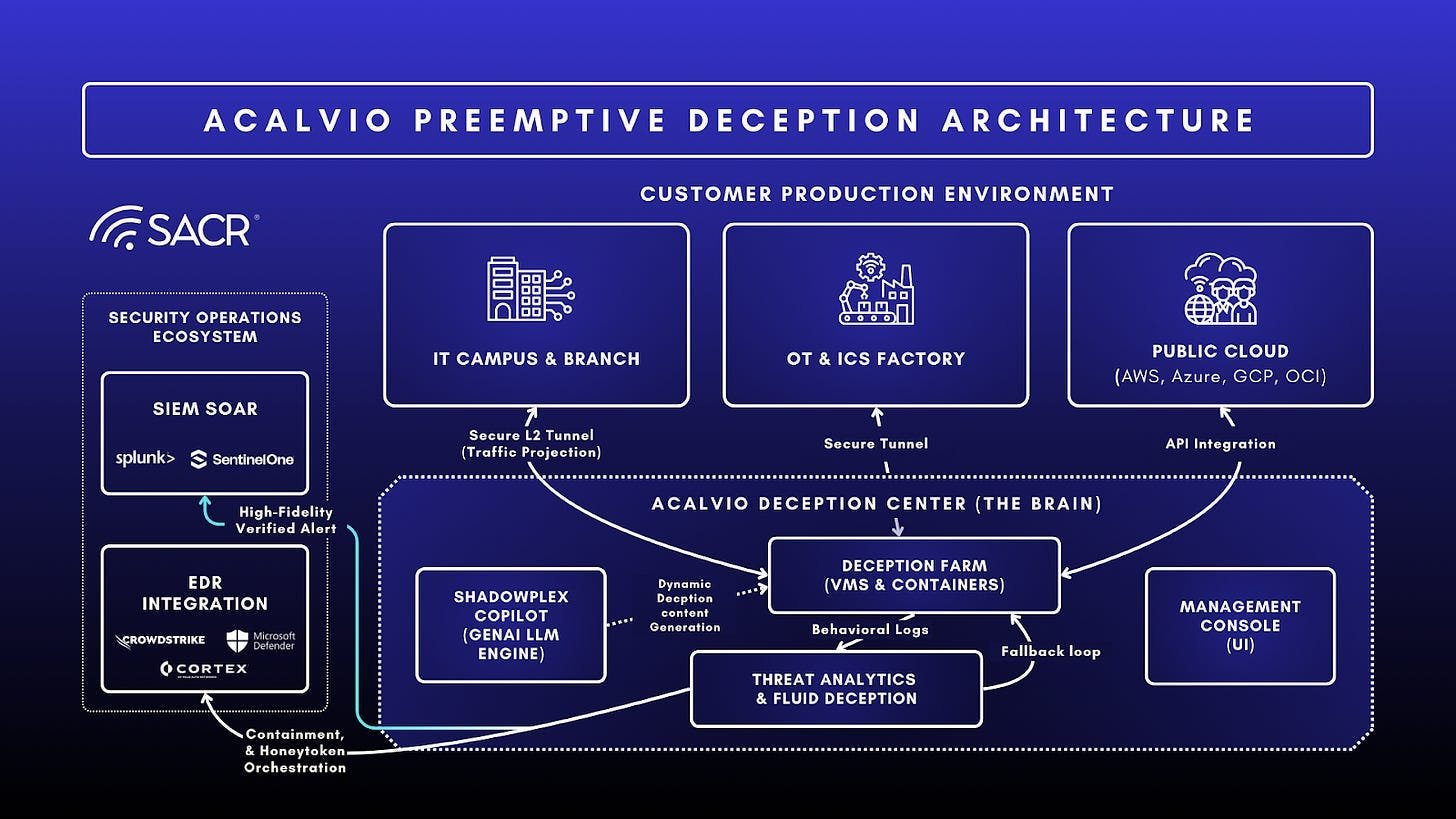
- Threat Exposure and Attack Path Analysis: Acalvio automates threat exposure and attack path analysis, evaluating assets, privilege relationships, and likely attack routes to determine where deception can have the greatest strategic impact. Rather than placing decoys manually, the platform positions deception assets along the paths an adversary is most likely to take. This analysis forms the foundation for the platform’s downstream deception and engagement activities.
- Autonomous Deception Creation (Generative Deceptions): To address the operational challenge of scale, Acalvio automates the creation of deception assets instead of requiring manual builds for every decoy, generating systems, credentials, cloud resources, and identity artifacts designed to align with the protected environment. SACR refers to this as generative deception creation: a capability that targets a real bottleneck in traditional deployments, though it has not yet been demonstrated at production scale.
- Identity-Centric Deception: Because identity has become one of the most valuable control planes for attackers, Acalvio extends deception into identity-centric attack paths through deceptive credentials, privileged account artifacts, and access relationships designed to appear operationally relevant while remaining isolated from production resources. This gives the platform a mechanism for detecting and influencing credential-based lateral movement specifically, not relying on network-level deception alone.
- Cloud-Native Deception: Acalvio extends deception into cloud control planes by generating deceptive cloud resources, credentials, and storage artifacts that mirror the API-driven, identity-dependent nature of cloud infrastructure. This follows attackers into management planes and storage services where much of today’s critical infrastructure resides, not just confining deception to endpoints and network infrastructure.
- Targeted Threat Intelligence: Acalvio’s targeted threat intelligence capability synchronizes deception content with the tactics, techniques, and behaviors most likely to target a specific enterprise, rather than relying on generic decoys. This contextual relevance is intended to make deception assets more believable and therefore more effective at attracting engagement, forming a feedback loop between threat intelligence, environmental visibility, and decoy deployment.
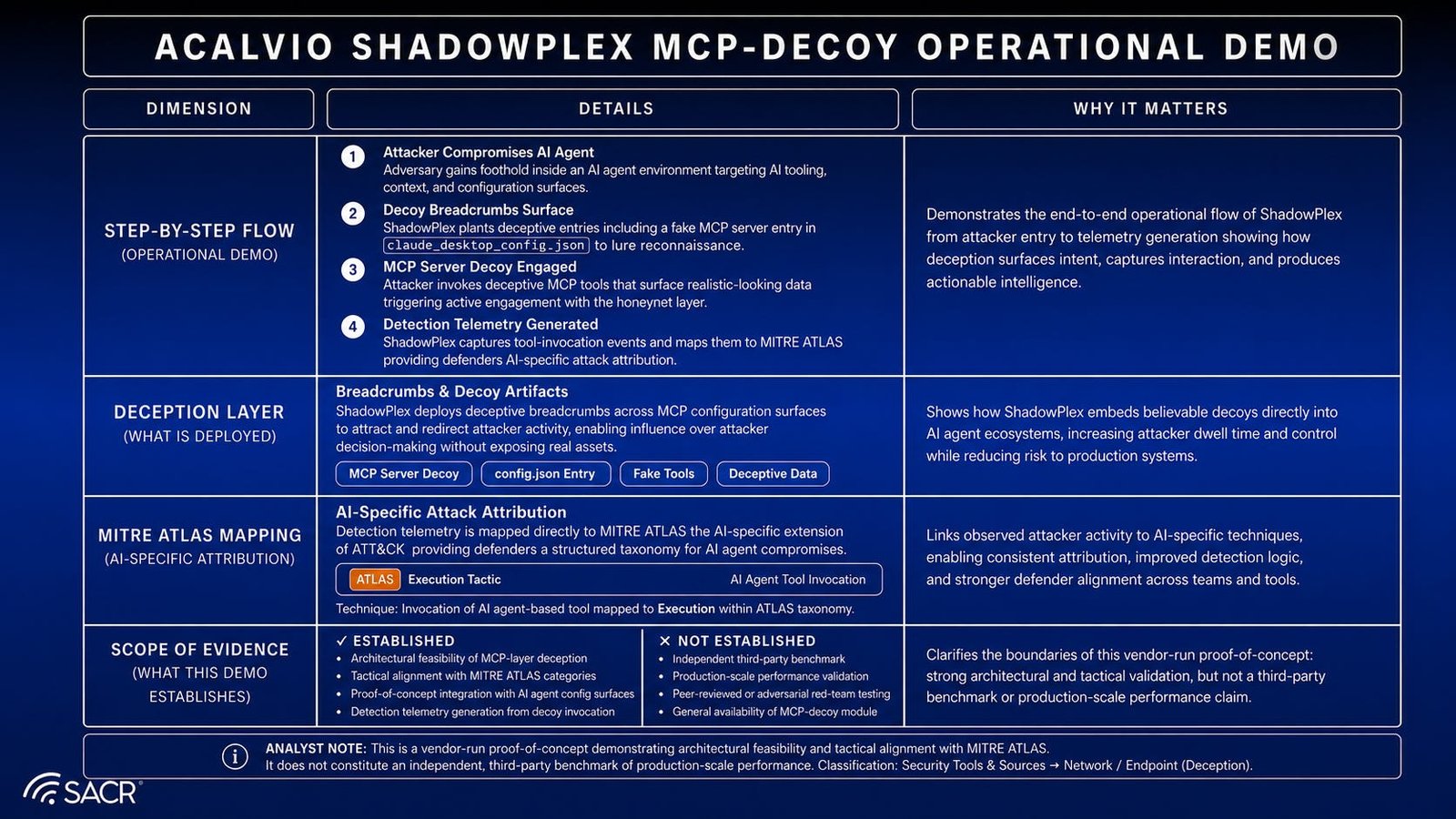
- AI Infrastructure Protection: Acalvio extends deception into AI-enabled environments, agent frameworks, retrieval systems, and MCP deployments, creating visibility into attack surfaces that fall outside traditional infrastructure. The specific mechanisms here (MCP decoys, deceptive tools, configuration breadcrumbs) are detailed under “MCP Decoys and AI Infrastructure Deception” later in this case study, where they connect to the MITRE ATLAS-mapped operational demo.
Acalvio’s ShadowPlex platform is designed around a continuous feedback loop in which deception assets evolve alongside both the protected environment and observed attacker behavior. Instead of deploying static decoys that require periodic maintenance, the platform attempts to automate the creation, placement, and adaptation of deceptive resources across identity systems, cloud infrastructure, enterprise networks, and emerging AI-enabled environments.
Operational Value
Individually, these six modules address distinct operational gaps: attack path analysis improves decoy placement, automated generation addresses scale, identity and cloud deception extend coverage into modern control planes, targeted threat intelligence improves realism, and AI infrastructure protection extends deception into emerging environments. Collectively, they form the foundation for the continuously adapting system described below.
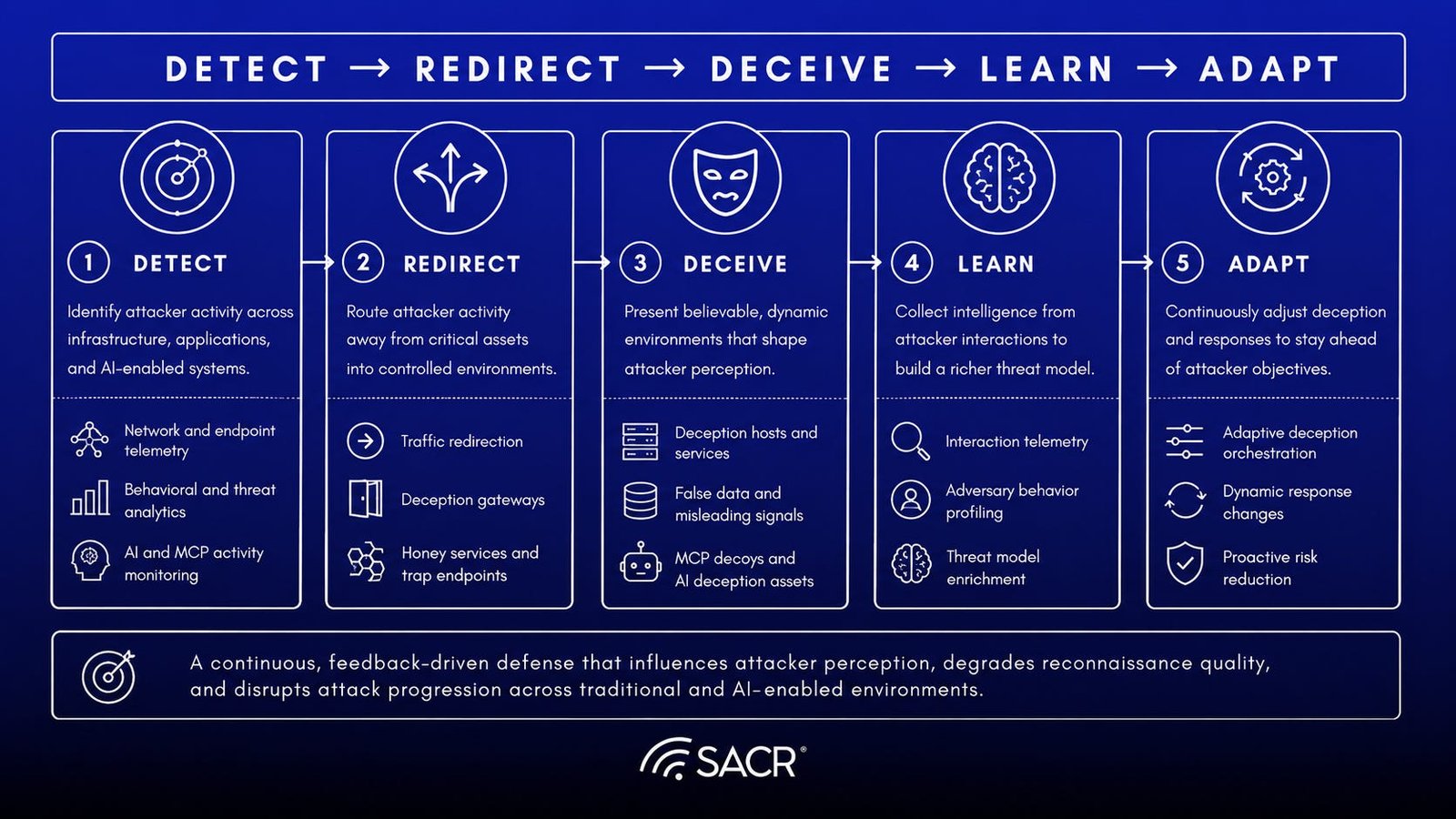
The Acalvio Workflow: A Continuous Loop of Influence
At a conceptual level, the workflow can be summarized as a continuous cycle:
Detect → Redirect → Deceive → Learn → Adapt
The platform seeks to connect these functions into an ongoing operational process. Information gathered during reconnaissance, credential access attempts, or lateral movement is intended to inform subsequent adjustments to the deception environment, creating a feedback loop that evolves as new activity is observed.
ShadowPlex as an Implementation of Adaptive Environmental Control
One of the distinguishing characteristics of Acalvio’s ShadowPlex architecture is that it treats deception not as a collection of individual decoys, but as a continuously operating defensive layer that evolves alongside the enterprise environment. This reflects a broader architectural shift discussed throughout this report: deception is moving from a static detection capability toward an adaptive environmental control designed to influence attacker behavior before traditional response processes begin.
Historically, most deception platforms have focused on placing believable but isolated artifacts throughout enterprise environments. Decoy systems, deceptive credentials, honeytokens, and fake services generated valuable telemetry when accessed by an adversary, but they generally remained passive until triggered. Their primary purpose was to reveal malicious activity after reconnaissance had already reached a deceptive asset.
ShadowPlex approaches the problem differently. Rather than treating deception as a discrete collection of traps, the platform attempts to model the surrounding environment and continuously adapt deceptive assets as identities, infrastructure, cloud resources, and attack paths evolve. In this model, deception becomes part of the operating environment itself and not just an isolated security capability deployed alongside it.
From an architectural perspective, this distinction is significant. Modern enterprise environments are increasingly dynamic. Cloud infrastructure scales automatically, identities gain and lose privileges, workloads migrate across platforms, and AI-enabled systems establish new relationships with enterprise data and external services. Static deception assets become progressively less believable if they fail to evolve alongside these changes. An adaptive control layer attempts to preserve realism by continuously aligning deceptive resources with the operational characteristics of the environment they are intended to emulate.
This shift also changes the defensive objective. Traditional deception platforms primarily sought to answer a binary question: Has an attacker interacted with an asset that should never have been accessed? Adaptive environmental control introduces a broader objective: Can the environment itself shape how an attacker understands, prioritizes, and navigates the enterprise before critical objectives are achieved?
In practical terms, this means deception is no longer evaluated solely by the alerts it produces. Its value depends on whether it can influence reconnaissance quality, alter attacker decision-making, generate higher-confidence operational intelligence, and create additional opportunities for defenders to intervene earlier in the intrusion lifecycle.
ShadowPlex illustrates one implementation of this architectural philosophy through a continuous operational cycle in which environmental observation informs deception generation, attacker interaction produces intelligence, and that intelligence contributes to subsequent adaptation. Rather than treating these activities as independent workflows, the platform seeks to integrate them into an ongoing feedback loop that evolves as both the protected environment and attacker behavior change.
This architecture aligns with a prevalent trend visible across multiple areas of cybersecurity. Identity security platforms now adjust trust decisions based on context. Cloud security continuously evaluates infrastructure posture as environments change. AI runtime security adapts policies according to agent behavior and data access patterns. Within this wider movement toward adaptive security, deception is evolving in a similar direction, from static artifacts toward continuously managed environmental controls.
Whether this architectural model ultimately becomes the dominant approach to deception remains an open question. Organizations should continue evaluating claims of autonomous adaptation through independent validation, production deployments, and measurable operational outcomes. Nevertheless, ShadowPlex demonstrates how deception can be reimagined as an adaptive security capability and not just an alert-generation mechanism. In doing so, it provides a useful illustration of the broader transition from passive observation toward active environmental influence that is reshaping this emerging category. The environment is not treated as static infrastructure but as a continuously evolving defensive surface.
How Acalvio Applies the Principles of Adaptive Deception
The platform demonstrates several of the architectural principles discussed earlier in this report.
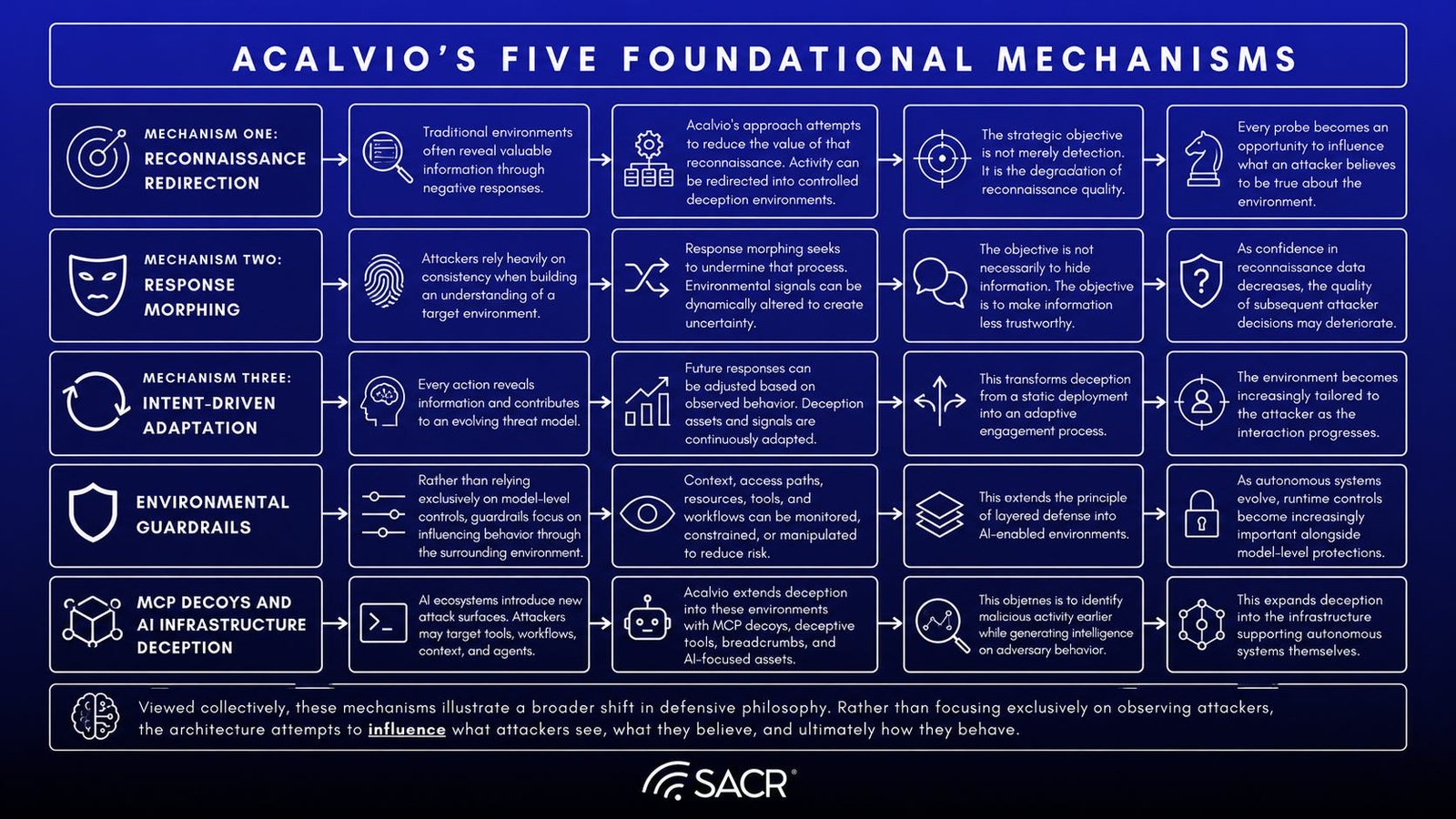
Degrading Intelligence: Reconnaissance Redirection and Steering
Traditional environments often reveal valuable information through negative responses. Closed ports, rejected connections, unavailable services, and error messages all help attackers build accurate maps of a target environment.
Acalvio’s approach converts unused infrastructure from a source of negative responses into an instrument of influence. By redirecting probes into controlled environments, the platform is designed to poison the attacker’s reconnaissance; if effective, the adversary’s model of the target is inaccurate from the first packet. Acalvio claims this degrades the quality of attacker intelligence in real time.
The strategic objective is not merely detection. It is the degradation of reconnaissance quality.
Every probe becomes an opportunity to influence what an attacker believes to be true about the environment. Rather than collecting intelligence passively, the environment begins participating in the engagement itself.
Undermining Trust: Response Morphing
Attackers rely heavily on consistency when building an understanding of a target environment. Service banners, operating system fingerprints, protocol responses, and configuration details all contribute to an attacker’s model of the environment.
Response morphing seeks to undermine that process.
During the briefing, Acalvio demonstrated how environmental signals could be dynamically altered to create uncertainty. For example, infrastructure that appears to belong to one platform may respond in a manner consistent with another. The information remains believable, but its accuracy becomes less reliable.
Consistency is an attacker’s greatest asset. The company argues that response morphing aims to disrupt that consistency. By dynamically altering service banners, fingerprints, and protocol responses, the platform aims to make environmental signals untrustworthy; replacing accuracy with believable friction intended to push the adversary and their autonomous agents toward indecision. Whether sophisticated adversaries adapt to this technique over repeated exposure is an open question, one SACR flags in the fingerprinting risk below.
Dynamic Defense: Machine-Speed Adaptation
The most significant aspect of the ShadowPlex architecture is the continuous reprogramming of deception based on observed activity. As Acalvio observes credential attempts or lateral movement, it adjusts deception assets in real-time to match inferred goals. This intent-driven adaptation is designed to ensure that attackers encounter an environment changing faster than it can be modeled, positioning deception as a primary security control that meets compressed attack timelines with equivalent speed.
Every action reveals information. Reconnaissance activity identifies areas of interest. Credential access attempts suggest objectives. Lateral movement activity reveals assumptions regarding network structure and available resources. Rather than treating these activities as isolated events, the platform incorporates them into an evolving threat model.
The underlying design principle is that the environment must be tailored to the attacker, and re-tailored continuously as the attacker’s inferred goals evolve.
Environmental Guardrails
Much of the current discussion surrounding AI security focuses on controls that operate inside the model itself, such as alignment training, safety tuning, prompt filtering, and policy enforcement.
Acalvio’s approach introduces a complementary concept: environmental guardrails.
Instead of relying exclusively on model-level controls, environmental guardrails focus on influencing behavior through the surrounding environment. Context, access paths, resources, tools, and operational workflows can all be monitored, constrained, or manipulated to reduce risk.
This approach reflects a broader security principle. Organizations have historically relied on multiple layers of defense, not merely trusting any single control. Environmental guardrails extend that philosophy into AI-enabled environments.
As autonomous systems become more deeply integrated into enterprise operations, runtime controls may become important alongside model-level protections.
MCP Decoys and AI Infrastructure Deception
One of the more forward-looking aspects of the architecture is its application to emerging AI ecosystems.
As organizations deploy AI agents, tool frameworks, retrieval systems, and Model Context Protocol (MCP) environments, entirely new attack surfaces are being created. These systems introduce opportunities for attackers seeking to manipulate workflows, poison context, abuse tools, or influence agent behavior.
Acalvio extends deception directly into these environments through concepts such as MCP decoys, deceptive tools, configuration breadcrumbs, and AI-focused deception assets.
The objective is to identify malicious activity earlier in the attack lifecycle while generating intelligence regarding how adversaries interact with AI-enabled systems.
This represents an important expansion of traditional deception. Historically, deception focused on networks, endpoints, and applications. Agentic deception extends those concepts into the infrastructure supporting autonomous systems themselves.
Viewed collectively, these mechanisms illustrate a broader shift in defensive philosophy. Rather than focusing exclusively on observing attackers, the architecture attempts to influence what attackers see, what they believe, and ultimately how they behave.
Where Acalvio Appears Differentiated
Based on SACR’s evaluation, several aspects of the platform stand out relative to the broader direction of the deception market.
Integration across multiple control planes. Instead of treating deception as a network-centric capability, the platform extends into identity, cloud, and AI-enabled environments.
Operational automation. The emphasis on automating deception generation and lifecycle management addresses one of the historical barriers to enterprise adoption.
Forward-looking AI strategy. Acalvio has invested early in deception techniques targeting AI-native environments, particularly MCP-based workflows and agent ecosystems. Although this area remains immature across the industry, it reflects a recognition that enterprise attack surfaces are expanding beyond conventional infrastructure.
These differentiators should be viewed within the context of a rapidly evolving market. Competing vendors are pursuing similar objectives through different architectural approaches, and the long-term competitive landscape has yet to stabilize.
Areas Buyers Should Validate
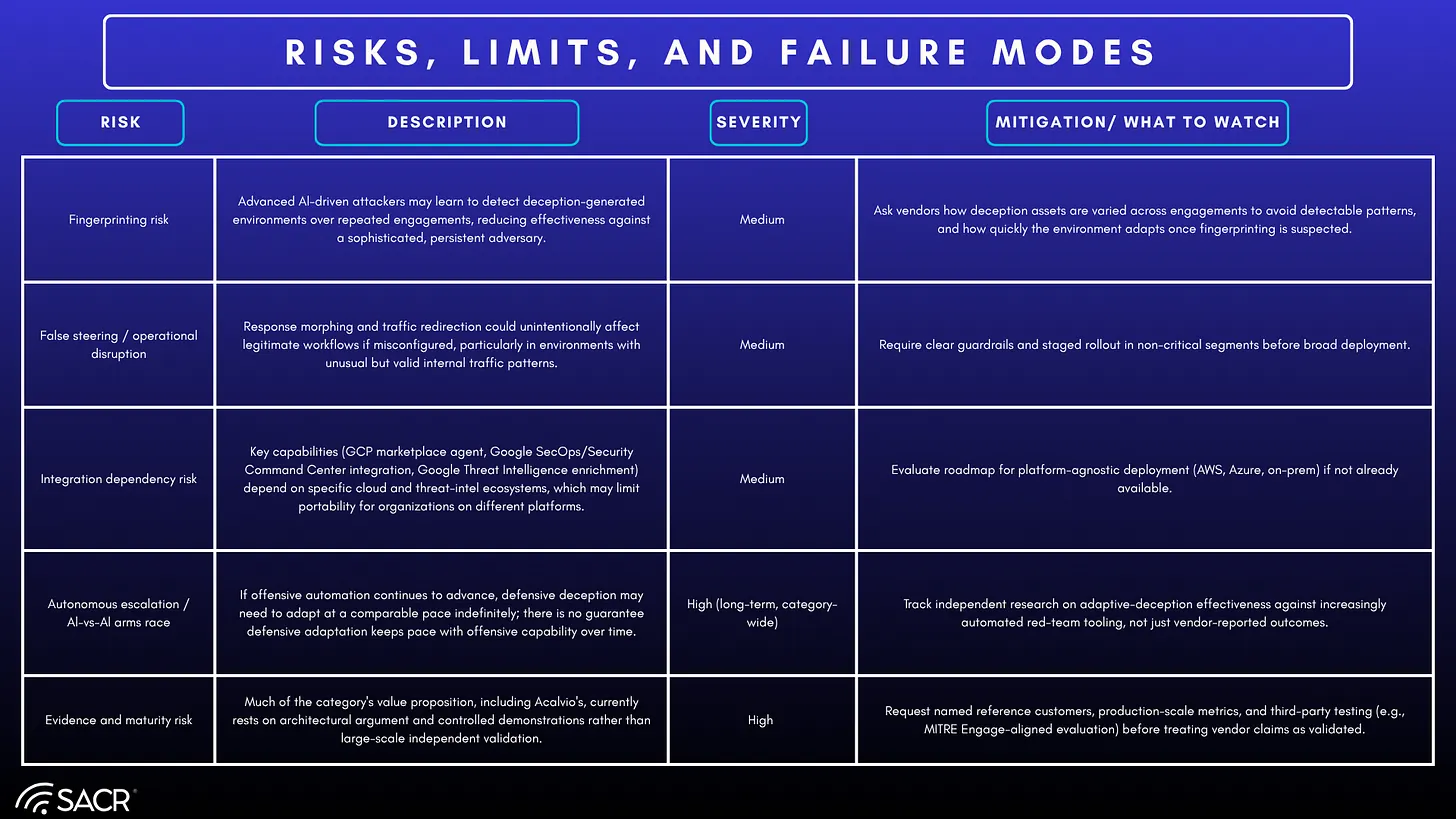
As with any emerging cybersecurity category, architectural vision should be accompanied by operational validation.
Organizations evaluating Acalvio should seek evidence in several areas:
- How effectively does continuous adaptation perform in large, dynamic enterprise environments?
- Can deception assets resist fingerprinting during repeated engagements?
- What measurable impact does adaptive deception have on attacker decision-making and incident outcomes?
- How much operational overhead is required to maintain believable deception at scale?
- How seamlessly does platform-generated intelligence integrate with existing SIEM, XDR, identity, and cloud security workflows?
- What independent customer evidence supports the platform’s claims?
These questions are not unique to Acalvio. They represent broader evaluation criteria for the agentic deception category as a whole and should form part of any procurement process.
SACR Assessment
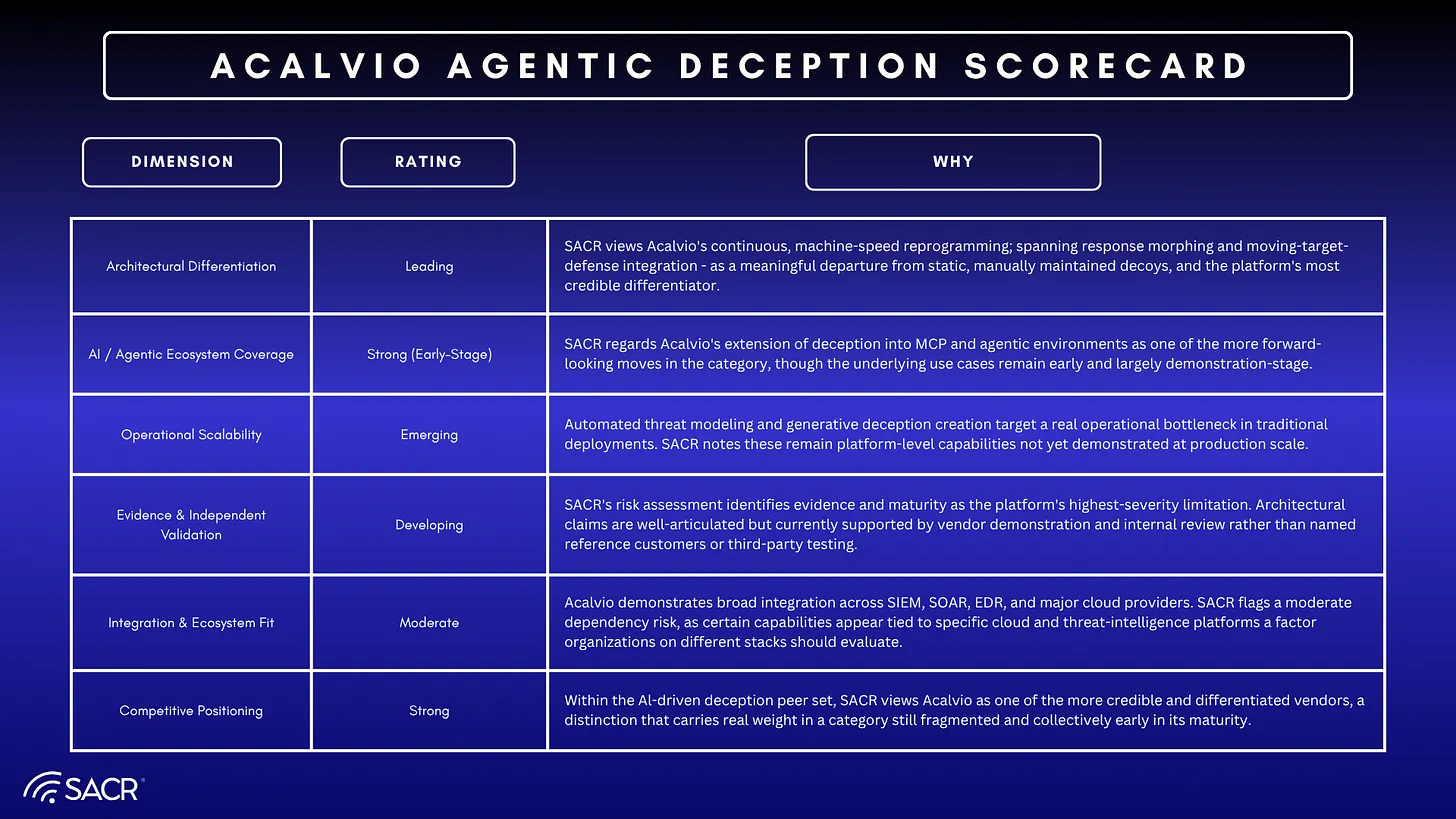
Overall, SACR views Acalvio as one of the more innovative vendors shaping the future of deception. While the broader category is still emerging, the company’s emphasis on adaptive defense, environmental influence, and AI-aware deception reflects where cybersecurity architectures are likely to evolve as organizations confront autonomous attackers and AI-enabled enterprise environments. For organizations exploring next-generation defensive strategies, Acalvio offers a differentiated vision that extends beyond traditional detection toward actively influencing attacker behavior.
Whether agentic deception ultimately becomes a foundational security category remains uncertain. However, the underlying direction is compelling. As organizations continue adopting automation and autonomous systems, defensive architectures may benefit from controls that do more than observe activity; they may also need to shape the conditions under which that activity occurs. Within that context, Acalvio offers a credible and differentiated vision of what adaptive cyber defense could look like in the years ahead.
Procurement Considerations for Security Leaders
The emergence of adaptive deception does not fundamentally change how organizations should evaluate security technologies. Rather, it expands the set of architectural questions security leaders should be asking as enterprise environments become dynamic and AI-enabled.
For many organizations, deception is unlikely to replace existing investments in identity security, endpoint protection, detection and response, or cloud security. Its value lies in complementing those controls by introducing additional opportunities to influence attacker behavior before critical objectives are achieved.
Security leaders evaluating deception platforms should therefore focus less on individual product features and more on how effectively those capabilities integrate into broader security operations.
Evaluate the Architecture, Not the Marketing
As the category matures, terminology is evolving rapidly. Vendors describe their platforms using terms such as adaptive, autonomous, AI-native, or agentic. While these labels may reflect genuine architectural innovation, they are not substitutes for demonstrable operational capabilities.
Instead, organizations should evaluate whether platforms can:
- adapt to changing enterprise environments with minimal manual effort;
- integrate across identity, cloud, endpoint, and AI-enabled ecosystems;
- generate actionable intelligence that improves broader security operations; and
- demonstrate measurable defensive outcomes beyond proof-of-concept environments.
Architectural maturity should ultimately be measured by operational effectiveness and not just product messaging.
Prioritize Operational Integration
Deception should strengthen existing security programs, integrating with them as a well-rounded capability.
Organizations should understand how deception-generated intelligence integrates with existing investments in SIEM, XDR, SOAR, identity security, cloud security, and incident response workflows. High-confidence detections are valuable only if they improve investigation, accelerate decision-making, and reduce operational complexity.
Similarly, adaptive deception should be evaluated within the broader security operating model. The technology is unlikely to deliver meaningful value if it introduces additional management overhead or requires extensive manual administration to remain effective.
Validate Adaptation, Not Just Detection
Many deception technologies have historically demonstrated their value by generating accurate alerts with relatively low false-positive rates.
Adaptive deception introduces a different claim: that the environment itself evolves as attackers interact with it.
This capability represents one of the most significant architectural shifts discussed throughout this report, but it is also one of the areas requiring the greatest scrutiny.
Organizations should therefore request evidence demonstrating:
- how deception adapts over time;
- how those adaptations improve defensive outcomes;
- whether adaptive behaviors remain effective against sophisticated adversaries; and
- how platform performance changes across large, dynamic enterprise environments.
The distinction between static automation and meaningful adaptation is likely to become an important differentiator as the market matures.
Consider AI as Part of a Broader Security Strategy
The rapid adoption of AI assistants, retrieval systems, autonomous workflows, and agent frameworks is expanding enterprise attack surfaces in ways that traditional security architectures were not designed to address.
While deception may provide useful visibility into these environments, it should be evaluated as one component of a broader AI security strategy that also includes governance, identity, runtime controls, application security, and data protection.
Organizations should avoid viewing any single technology as sufficient for securing AI-enabled environments. Instead, the objective should be to combine complementary controls that reduce both the likelihood and impact of autonomous attacks.
Questions Every Buyer Should Ask
Before selecting an adaptive deception platform, CISOs should be able to answer several practical questions.
- What operational problem is this platform solving that existing controls do not?
- How does it integrate with the organization’s current security architecture?
- Can it demonstrate measurable improvements in detection quality, attacker disruption, or investigation efficiency?
- How much operational effort is required to maintain realistic deception environments?
- What independent customer evidence supports the vendor’s architectural claims?
- How effectively does the platform extend across cloud, identity, and AI-enabled environments?
- What metrics will be used to determine whether the deployment has been successful?
These questions are ultimately more important than any individual capability. As with many emerging cybersecurity categories, long-term value will depend on operational outcomes, not architectural ambition alone.
Final Assessment
The renewed interest in deception reflects a broader transformation occurring across enterprise cybersecurity. As organizations deploy autonomous systems and attackers continue to automate reconnaissance, exploitation, and decision-making, security architectures built primarily around human-speed detection and response are being reevaluated.
Agentic deception represents one response to that shift.
Rather than focusing exclusively on identifying malicious activity after it has begun, adaptive deception explores whether defenders can influence the information, context, and environmental conditions that attackers rely upon throughout an engagement. Whether this approach ultimately becomes a foundational component of enterprise security remains uncertain. The category is still evolving, independent validation remains limited, and implementation maturity varies considerably across vendors.
Nevertheless, the underlying architectural direction is significant.
The future of cyber defense is unlikely to be defined by a single technology category. Instead, organizations will move towards combining identity security, runtime protection, cloud security, AI governance, detection and response, and adaptive controls into integrated security architectures capable of operating continuously across highly dynamic environments.
Within that broader evolution, deception appears to be moving beyond its historical role as a niche detection capability toward a more strategic function focused on environmental influence and operational intelligence.
Among the vendors contributing to this transition, Acalvio presents one of the more comprehensive implementations currently available. Its emphasis on continuous adaptation, identity- and cloud-centric deception, and AI-enabled environments aligns closely with several of the architectural trends shaping the market. While many of its longer-term claims remain to be validated through broader enterprise adoption, the platform provides a credible illustration of how adaptive deception may evolve over the coming years.
The strategic importance of deception in that environment is that it targets one of the most critical dependencies shared by both humans and machines: information. Ultimately, the significance of agentic deception lies less in any individual implementation than in the question it asks of modern security architecture:
If attackers rely on autonomous systems to understand and navigate enterprise environments, should defenders continue focusing solely on observing those systems, or should they also seek to influence what those systems perceive?
The answer will vary across organizations and will continue to evolve alongside the technology itself. What appears likely, however, is that the next generation of enterprise security will place greater emphasis not only on detecting attacks, but on shaping the conditions under which they unfold.
Disclosure: This report is commissioned and sponsored by Acalvio. SACR retains full editorial control, independence, and objectivity. Acalvio’s role is limited to providing briefing access, customer contacts, and factual review. Sponsorship does not influence SACR’s findings, competitive analysis, or recommendations.
Sources & Further Reading
Vendor Briefings and Product Materials
- Acalvio product demonstrations (2026)
- Acalvio technical briefings
- Acalvio ShadowPlex architecture documentation
- Acalvio MCP operational demonstration
- Acalvio solution documentation
Research & Standards
- IBM. Cost of a Data Breach Report 2025.
- Verizon Business. 2026 Data Breach Investigations Report (DBIR).
- MITRE Corporation. MITRE ATT&CK Framework.
- MITRE Corporation. MITRE Engage.
- National Institute of Standards and Technology. AI Risk Management Framework (NIST AI RMF 1.0).
- OWASP Foundation. OWASP Top 10 for Large Language Model (LLM) Applications.
- Microsoft. Microsoft Digital Defence Report.
- From Vulnerability to Exploitation – time-to-exploit dataset.