The managed detection and response market reached $9.6 billion in 2025 and is projected to grow to $46.9 billion by 2035, reflecting a 17.2% compound annual growth rate driven by rising cyber threats and increasing highly skilled analyst shortage. Despite this growth, operational challenges still remain. According to the 2025 SANS SOC Survey, 69% of SOCs still rely on manual or mostly manual processes to report metrics, and only 42% of organizations use AI and machine learning tools with any customization. The consequences are measurable. Research shows that 61% of organizations admit to ignoring critical alerts that later caused breaches, exposing the gap between detection capability and actual response capacity. The market is now splitting between organizations that can staff internal SOCs and those that cannot. Large enterprises are exploring agentic AI platforms to augment existing security teams, while small and mid-market organizations increasingly turn to AI powered MDR providers for 24/7 coverage they cannot build internally.
AI is fundamentally transforming managed detection and response. What makes this moment particularly significant is the convergence happening between AI SOC platforms and MDR services. For years, security teams relied on a mix of SIEM, EDR, and MDR vendors, but these stacks created their own problems including endless alert noise, long investigation times, and overworked analyst teams stuck in repetitive triage. Now, AI SOC platform vendors are recognizing that many organizations need more than tools, they need the accountability and outcomes that come with managed services. This is driving AI SOC companies to expand into MDR service delivery, blurring the line between platforms and services. The result is a new category: AI-native MDR that combines the automation capabilities of agentic AI platforms with the human oversight and accountability transfer that organizations require.
This report examines how AI is changing MDR services and why it matters for security leaders. We look at two paths organizations are taking: building internal SOC capabilities with AI platforms versus outsourcing to AI-powered MDR providers. The key question is whether mid-market companies will bring these tools in-house or continue paying for managed services that deliver outcomes and accountability. We analyze how vendors are moving between selling platforms and offering services, why traditional MDR economics are breaking down, and what use cases are driving adoption across different company sizes. Security leaders will find practical guidance on evaluating AI-powered security operations, important questions to ask, understanding when to build versus buy, and bridging the gap between threats and the solutions vendors are actually delivering today.
Authors:
- Aqsa Taylor is the Chief Research Officer at Software Analyst Cyber Research, where she leads research initiatives and the CISO Arm (security leaders community). She is a published author with over a decade of experience building cloud security platforms and experience consulting more than 44% of Fortune 100 organizations on their security posture.
- Francis Odum is the Founder/CEO of the Software Analyst Cyber Research, where he leads the firm’s research and engagement with cybersecurity leaders.
- Kyle Kurdziolek is a VP of Security at BigID shaping the future of AI-driven cybersecurity. He translates complex threats into practical, data-driven strategies that streamline operations, reduce alert fatigue, and modernize risk management. Known for building high-impact teams and developing the next generation of security leaders, he blends technical expertise with a forward-thinking vision for the industry.
- Josh Trup is Principal at Greenfield Partners, a global early-growth technology investment fund. Greenfield was spun out of TPG Growth in 2020, backing category-defining tech companies worldwide.
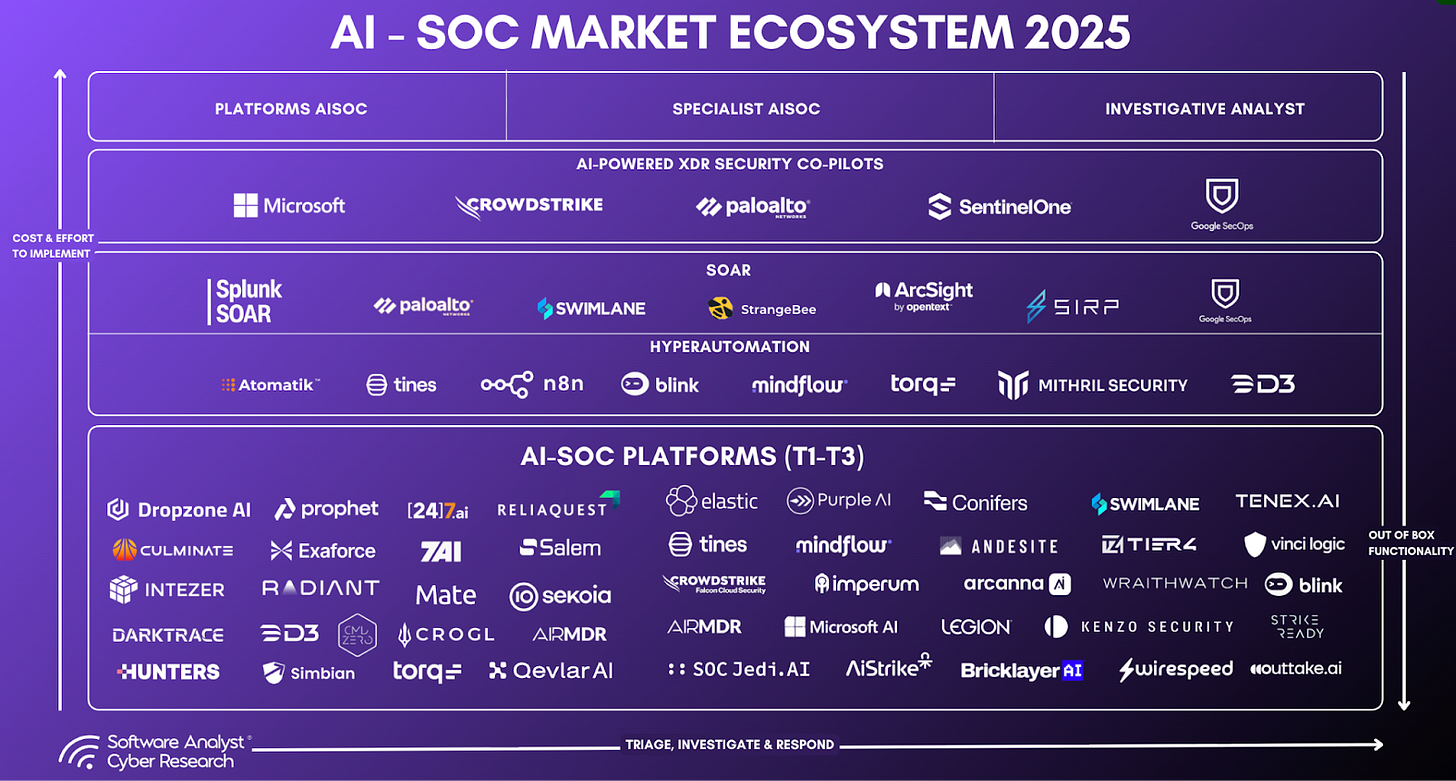
Disclaimer: This report is not a market map and should not be interpreted as a comprehensive survey of the AI SOC or MDR vendor landscape. The AI SOC ecosystem is broad and rapidly evolving, and its exhaustive coverage was not the objective. Instead, this analysis focuses on understanding how AI SOC–powered platforms are reshaping Managed Detection and Response by examining a representative sample of vendors selected to highlight meaningful differences in technical architecture, operational models, and customer depth.
Executive Summary
Here are some key insights from the report –
Why MDR Is Under Pressure
Managed Detection and Response has become harder to run and harder to justify. Alert volumes keep growing, environments are more complex, and skilled analysts are still hard to hire and retain. Traditional MDR services rely on people doing triage and investigations around the clock. That model does not scale cleanly. Costs rise with headcount, investigation quality depends on which analyst you get, and consistency drops as providers grow.
Most organizations did not adopt MDR because it was perfect. They adopted it because running a 24/7 SOC in-house was not realistic. That problem has not gone away. What has changed is the technology available to solve it.
What AI SOC Means for MDR
AI-powered SOC platforms are changing how MDR is delivered. Instead of using automation to assist humans, these platforms let AI handle most of the investigation work directly. The system gathers context, correlates activity across tools, tests hypotheses, and reaches a conclusion. Humans step in when confidence is low, when business impact is high, or when response decisions need approval.
This shift matters because it removes the biggest bottleneck in MDR. Investigations no longer depend on how many analysts are on shift or how experienced they are. AI can investigate every alert, every time, using the same logic and the same depth. That leads to faster response, fewer missed signals, and far less noise reaching security teams.
Better Decisions, Not Just Faster Ones
The value of AI SOC in MDR is not just speed. It is decision quality. The platforms reviewed in this report show that AI can connect weak signals across identity, cloud, endpoint, SaaS, and network data in ways humans struggle to do at scale. Investigations are more complete because the system does not get tired, does not cut corners, and does not ignore low-priority signals that later turn out to matter.
Several vendors now claim that only a small percentage of cases need human review. While this varies by environment and maturity, the direction is clear. AI is taking on the work that causes fatigue and inconsistency, while humans focus on judgment and accountability.
Detection Quality Becomes Part of the Service
Another important shift is that detection quality is no longer treated as a separate problem. AI SOC platforms observe which alerts are useful, which are noisy, and which gaps exist. Over time, they tune detections, suppress false positives, and in some cases generate new detection logic.
For CISOs, this changes the conversation. Instead of asking why analysts are overwhelmed, the question becomes why so many low-value alerts exist in the first place. AI-driven MDR services begin to fix the problem at the source rather than managing around it.
Context Is the Difference Between Noise and Risk
Attacks today often look like normal behavior. Without context, MDR services either escalate too much or miss real issues. The strongest AI SOC platforms build an understanding of how each organization works. They learn which tools are approved, how different teams behave, what normal looks like for new hires versus senior staff, and where risk tolerance differs.
This context allows the system to make better calls. It also allows MDR services to deliver fewer, higher-quality escalations that security teams can trust.
Trust Requires Transparency
As AI takes on more responsibility, trust becomes critical. Security leaders need to know how decisions are made. The leading platforms in this report make explainability a core feature. Every investigation shows what data was used, what steps were taken, and why a conclusion was reached.
This level of transparency is essential for audits, compliance, and board discussions. It is also how teams build confidence in AI over time.
Different Models for Different Organizations
The report shows a clear split in how organizations adopt AI SOC capabilities. Large enterprises tend to use AI to support internal SOC teams. They keep decision authority in-house and gate automation carefully. Mid-market and smaller organizations are more likely to adopt AI-native MDR services where responsibility is shared or transferred to the provider.
Neither approach is right or wrong. The difference comes down to risk ownership, governance, and operational capacity.
What CISOs Should Take Away
AI SOC–powered MDR is not about removing people. It is about using people where they add the most value. AI handles the volume and the repetition. Humans handle judgment, business context, and accountability. For security leaders, the key questions are not about features. They are about ownership. Who owns the decision. Who owns the failure. How does the system explain itself? How does it improve over tim?.
Organizations that align AI SOC adoption with their maturity and risk tolerance will see real gains in speed, consistency, and cost. Those that treat AI as a simple add-on will not. The future of MDR is not fully automated and it is not fully human. It is a deliberate balance between the two. As organizations confront an accelerating volume of alerts, expanding attack surfaces, and a persistent shortage of skilled security talent, the traditional Managed Detection and Response (MDR) model is approaching its structural limits. Human-led MDR services built around 24/7 analyst staffing, manual triage, and labor-intensive investigations that do not scale cleanly. Costs rise linearly with headcount, service quality varies by analyst assignment, and consistency degrades as providers grow.
AI-powered Security Operations Centers (AISOCs) are emerging as the next evolutionary step, redefining how MDR services are delivered. Rather than layering automation onto human-centric workflows, AISOC-driven MDRs rebuild the service model around machine-led investigation and response, with humans operating primarily in supervisory, exception-handling, and governance roles.
What Is AISOC for MDR?
AISOC for MDR refers to the application of advanced AI ranging from large language models to agentic automation across the full SOC lifecycle: detection, enrichment, triage, investigation, and response. Unlike legacy MDR offerings, which depend on continuous human attention, AISOC-driven MDRs rely on AI systems to conduct the majority of investigative work autonomously, escalating only high-uncertainty or high-impact cases to human analysts.
This shift materially changes both operational outcomes and service economics. Machine-led investigation eliminates analyst fatigue and variability, enabling true 24/7 coverage with consistent decision quality. Mean time to detect and respond (MTTD/MTTR) improves not simply because actions are faster, but because investigations are executed deterministically, with complete context stitched across telemetry, identity, endpoint, and cloud signals.
Several AI-native MDR providers claim that their AI analysts investigate nearly all incoming alerts, with only a small fraction often cited at ~3% requiring human intervention. This allows dramatically higher customer-to-analyst ratios and more predictable service quality, making the model particularly attractive to mid-market organizations that cannot afford to staff or manage an internal SOC.
How AISOC Changes MDR Economics and Delivery
AISOC-driven MDR fundamentally alters the unit economics of managed security services. In traditional MDR, quality is constrained by human availability, skill distribution, and burnout. As providers scale, maintaining consistent investigation depth becomes increasingly difficult. In an AI-native model, the opposite dynamic becomes possible: investigative logic improves as systems process more incidents and environments, allowing learning to compound at the platform level rather than being fragmented across individual analysts.
Operationally, AISOC platforms increasingly support automated containment, isolation, and remediation actions. Some platforms enable autonomous response for clearly defined, high-confidence scenarios while preserving human approval for sensitive actions. Others focus on explainable, natural language-driven playbooks that reduce the need for brittle SOAR engineering and make response logic easier to audit, tune, and govern. Deterministic automation frameworks further ensure that every action is traceable and defensible; an essential requirement as MDR providers assume greater responsibility for outcomes.
The net effect is a service model that delivers faster response times, more consistent investigations, and lower marginal cost per customer. Importantly, these benefits are not driven solely by cost reduction; they emerge because automation replaces linear human labor with scalable systems capable of operating under sustained load.
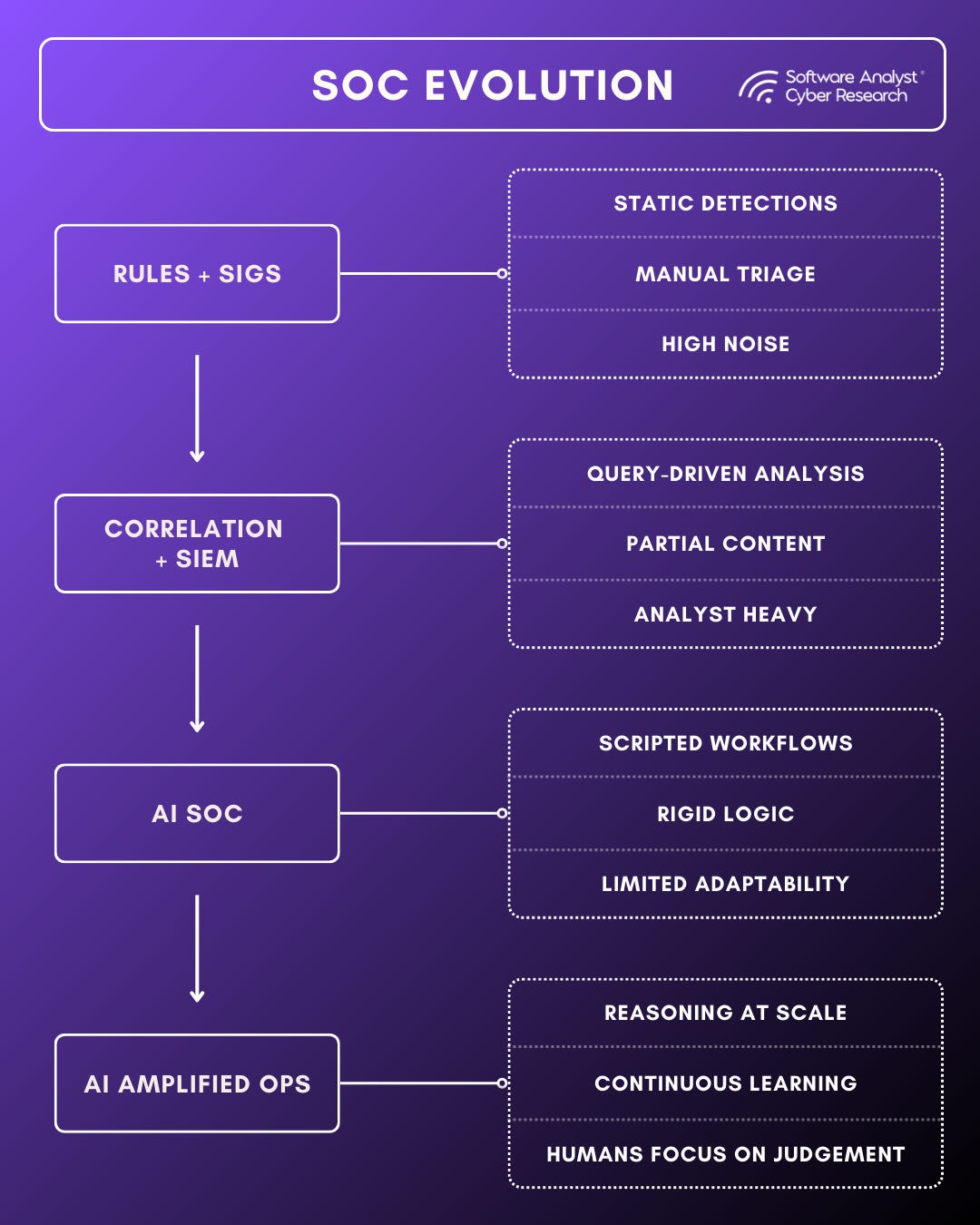
Evolution of Security Operations
Traditional security operations centers were built for a very different era of cybersecurity. They were designed around signatures, rules, and discrete alerts generated by a growing ecosystem of vendor technologies. Analysts relied on correlation engines and complex queries to stitch together activity across log sources, identity systems, endpoints, and networks. As telemetry volumes exploded, even the most resourced SOCs found themselves overwhelmed. To cope, teams narrowed detection scopes and tuned aggressively, sacrificing visibility in exchange for what felt like a manageable workload.
This operational burden fell squarely on analysts. Large portions of their time were spent on repetitive enrichment tasks, manually pulling context from logs, threat intelligence feeds, asset inventories, and identity systems just to determine whether an alert was meaningful. SOAR platforms promised relief, but in practice they automated only small, brittle segments of the workflow. Fatigue continued to mount, while proactive threat hunting, environmental learning, and post-incident analysis were deprioritized simply to keep up with the backlog of alerts.
Several forces are now driving a rethinking of this model. The volume and velocity of data continue to increase. Attack techniques are more adaptive and blend into normal behavior.
Talent remains scarce, expensive, and hard to fill. At the same time, organizations have become more comfortable running AI in production across revenue generating and critical systems. That comfort has not appeared overnight. It has been shaped by years of operating machine learning driven fraud detection, recommendation engines, and capacity planning systems. Security is no longer the first place AI is trusted, but it is no longer the last either.
The growing operational comfort is what makes AI adoption in the SOC more realistic today. Preparedness comes from starting with augmentation rather than autonomy, demanding explainability, and grounding models in environment specific data. When AI is trained on how an organization actually operates, rather than generic threat patterns, trust develops naturally through repeated validation. Analysts see better prioritization, fewer dead ends, and clearer reasoning. Leadership sees reduced dwell time and more consistent outcomes without surrendering accountability.
The comparison between traditional in-house SOC platforms and MDR offering further accelerates this shift. Many organizations already rely on MDR providers because they cannot sustainably staff, operate 24/7, and also don’t want liability for the organization. MDR has already proved that outsourcing analysis and triage could work when paired with human expertise and clear escalation paths. Yet a problem still existed, as it caused fatigue when MDRs do not translate that human expertise to their technologies. Now, AI-MDRs can make this shift for the better and offer similar capabilities as an in-house AI-SOC. However, in-house AI-SOC capabilities represent an evolution, but one that keeps institutional knowledge inside the organization. Instead of sending telemetry out, intelligence is brought inward, embedded directly into daily workflows and decision making. It is all about organizational preference, how the data is handled, amount of risk willing to accept, and if they want to accept liability for bringing it in house. Transparency and clear escalation pathways are always non-negotiable no matter which approach is chosen.
The financial story reinforces this transition. Organizations are already spending heavily on MDR services, overlapping tools, and labor intensive operations. AI-driven SOC capabilities are increasingly viewed as an investment in efficiency rather than experimental expense. Savings come not only from reduced reliance on external services, but from better utilization of existing teams. Analysts spend less time validating noise and more time solving meaningful problems. Over time, improved decision quality reduces incident impact, repeat findings, and operational drag, creating a compounding return that leaders understand and support.
The introduction of AI-SOC in MDR allows security operations to be reimagined without narrowing detection breadth. Instead of suppressing data, teams can allow AI to process streams of telemetry and surface the alerts that actually matter. The system can learn what normal looks like in a specific environment and identify deviations that warrant attention. What once required hours of manual effort can now be presented in moments, allowing humans to engage earlier with far better information.
Voice of Security Leaders
In my last report on Security Data Pipeline Platforms, I talked about the fundamental practitioner concerns related to SOC operations, based on interviews, surveys, and insights from security leaders. Security Data Pipeline Platforms (SDPPs) address the first half of the challenge, which is the data clarity problem. The second half concerns detection and response platforms. Francis and Rafal’s report on the AI SOC market landscape does a good job of explaining the fundamentals of what constitutes an agentic AI SOC platform and the architecture evolution. It highlights. This report focuses on how AI SOC platforms are transforming the MDR (Managed Detection and Response) industry.
We spoke with security leaders about their biggest challenges within the SOC. According to them, these are the top challenges that create opportunities for AI SOC and AI MDR platforms to address:
Alert overload and staffing constraints
Security teams spend four times more budget on people than tools, yet they still drown in alerts. Many organizations receive thousands of alerts per week and cannot investigate them thoroughly. Internal SOCs can cost more than a million dollars a year. SMBs simply cannot afford this, and traditional MDR models still rely heavily on humans. This creates slow, inconsistent triage and burnout.
Lack of skilled analysts
For organizations, finding L3 analysts and a team with deep skills has been brought up as an additional gap. The real challenge is that SOC work has fundamentally changed, but training and hiring haven’t kept pace. Analysts face alerts from 28+ tools on average, must understand cloud-native architectures, need to correlate identity and runtime signals, and should think strategically about coverage gaps, all while the industry still hires primarily for SIEM skills and endpoint knowledge.
Data complexity and inefficient investigations
Raw logs from cloud, SaaS, identity, and endpoints require analysts to write complex queries, pivot through multiple systems, and manually reconstruct what happened. Some SIEMs still require SQL-style queries for basic searches. Investigations often take more than an hour because tools do not translate events into real-world meaning.
Detection coverage gaps
New services such as Snowflake, GitHub, and Google Workspace generate critical activity with little native detection. Many teams also deploy rules without knowing how they map to their environment. Threat intelligence remains disconnected from actual coverage. The result is blind spots and reactive security.
Institutional knowledge loss
SOC workflows depend heavily on human memory. Playbooks live in individual brains, not systems. When people leave, context leaves with them. SOAR proves too rigid because it requires constant upkeep. AI tools that don’t learn from past investigations repeat mistakes and lose context.
A reset moment for SOC teams
Across interviews, one theme is clear: SOCs are entering a reset phase. Data management is changing, cloud detection is shifting, and AI introduces an entirely new layer of observability and risk that most organizations have not yet prepared for.
Understanding SOC and Agentic Impact
The Central Question that security leaders are asking: Is the Agentic SOC Real or Marketing?
Across the conversation, there is strong consensus that:
- Tier 1 automation (triage, enrichment, false-positive reduction) is real and many cases production-ready
- Tier 2+ autonomous investigation and response remains fragile, narrow, and highly context-dependent
- Full “lights-out SOCs” are not trusted by practitioners, especially in regulated or lean security teams
The question is no longer “Can agents do SOC work?” It is “Who owns the failure when agents are wrong?” This becomes decisive in adoption patterns.
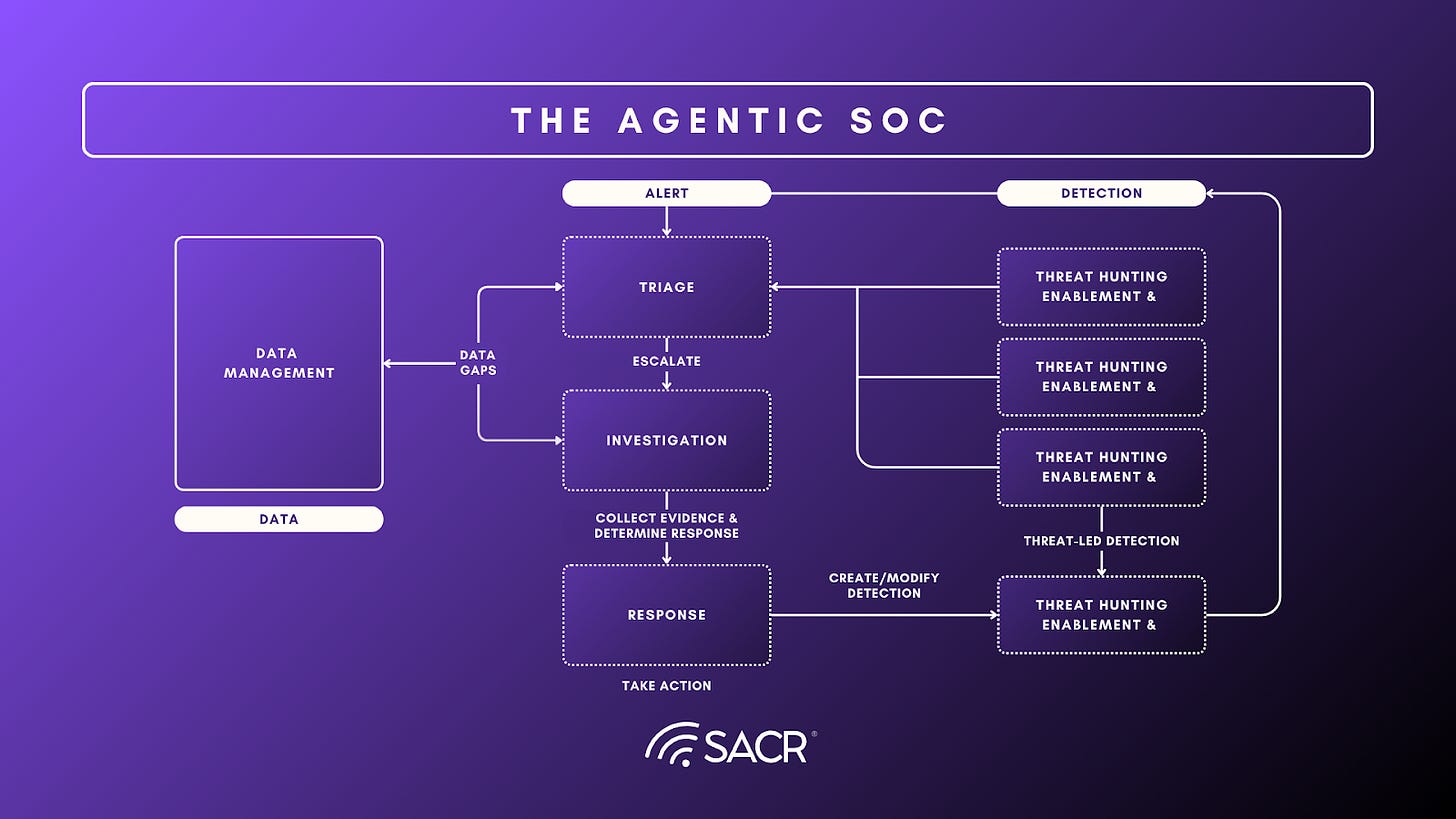
Source Ref: https://cloud.google.com/blog/products/identity-security/the-dawn-of-agentic-ai-in-security-operations-at-rsac-2025
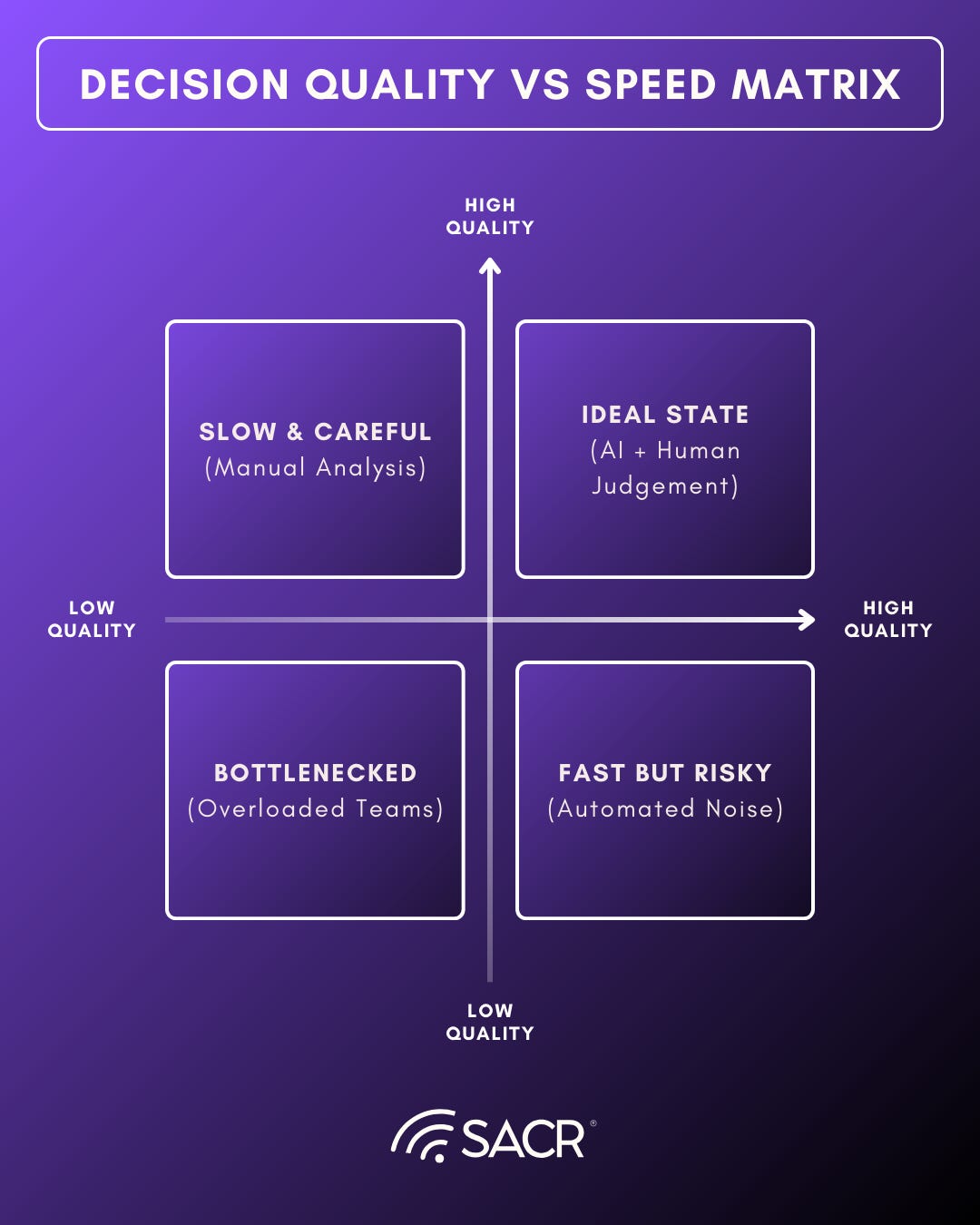
Decision Quality vs Speed
AI is changing how security operations are built, but it is not pushing organizations toward a single operating model. Instead, it is expanding the range of viable choices based on maturity, risk tolerance, and governance capacity. The most important factor is not whether AI is used, but where responsibility for outcome resides. Some organizations need immediate coverage and risk transfer. The ideal state is being able to internalize decision making and compound learning over time. Where the future is making humans faster, more consistent, and far better prepared when incidents occur. There is an underlying distinction today, and is critical to evaluate whether AI SOC platforms or AI MDR services are the right fit at a given stage. This is where ideal models would align as organizations evolve.
Reducing Burden to Invest in Efficiency
Across all maturity stages, one of the clearest benefits of AI driven operations is the space it creates. When repetitive enrichment, correlation, and initial assessment are handled consistently and accurately, security teams can redirect effort toward areas that compound the initial AI SOC value.
Detection engineering improves when the teams have time to analyze missed signals and refine logic. Automation and remediation workflows become more robust when they are designed thoughtfully rather than reactively. Incident learnings are more likely to feed back into architecture and controls. AI does not eliminate the work, but it elevates it.
The State of the SOC and MDR Market
Traditional MDR has reached meaningful scale, with leading vendors generating hundreds of millions in annual recurring revenue. However, the model remains structurally constrained. Margins average approximately 10%, reflecting a service delivery approach that is heavily dependent on human labor. As a result, revenue growth remains closely tied to incremental headcount. AI-native MDR providers are challenging this structure by rebuilding operations around machine-led investigation.
Traditional MDR’s Scale and Weakness:
Over the past two decades, the MDR market has produced several large, scaled providers, such as Arctic Wolf, Expel, Secureworks, and others, with hundreds of millions of dollars in recurring revenue. This scale validates sustained demand for outsourced security operations. MDR exists because staffing, training, and retaining a 24/7 SOC is operationally complex, talent-constrained, and economically inefficient for most organizations.
Yet the same model that enabled MDR to scale now imposes a hard ceiling on its economics and performance. Traditional MDR delivery remains fundamentally human-led. Analysts are responsible for alert triage, investigation, escalation, and response across heterogeneous customer environments. While incumbent providers have invested heavily in tooling, playbooks, and automation, these investments have improved efficiency only at the margins. They have not altered the core cost structure. Incremental growth still requires incremental headcount, particularly for Tier 2 investigation and continuous coverage.
This creates a persistent mismatch between value delivered and value captured. Customers expect improving detection and response outcomes at stable or declining prices, while providers face rising labor costs, analyst burnout, and chronic retention challenges. In practice, this tension manifests in a way buyers know well: high contract prices paired with uneven service quality. The effectiveness of a traditional MDR engagement often hinges less on the underlying platform and more on the specific analysts assigned to the account. Strong teams deliver acceptable outcomes; weaker teams generate alert fatigue, excessive false positives, and slow or shallow investigations.
At scale, this variability is unavoidable. Human-led services struggle to deliver consistent depth, speed, and judgment across thousands of customers simultaneously. Even best-in-class incumbents are constrained by the realities of analyst availability, experience distribution, and operational load. The result is a market where many organizations pay a premium for protection that is sufficient most of the time, but fragile under pressure.
The AI-First Disruption
AI-native MDR is emerging as a direct response to these structural limitations. Rather than layering automation onto an analyst-centric operating model, a new class of providers are rebuilding MDR around a different unit of work: machine-led investigation and response, with humans operating primarily in supervisory, exception-handling, and escalation roles.
The defining shift is not simply faster execution or lower cost. It is a change in how service quality behaves at scale. As mentioned, in traditional MDR, quality is constrained by human variability: analyst skill, fatigue, turnover, and staffing ratios. As providers grow, maintaining consistent investigation depth and response quality becomes increasingly difficult. In an AI-native model, the opposite dynamic becomes possible. As systems process more incidents, environments, and adversary techniques, investigative logic can improve systematically. Learning compounds at the system level rather than being fragmented across individual teams.
Where this approach works, service quality becomes less dependent on which analysts are assigned to an account and more dependent on the maturity of the underlying system. False positives can be reduced through improved correlation, context stitching, and confidence scoring. Investigations can become deeper and more consistent as evidence gathering and hypothesis formation are standardized. Over time, the service improves not through staffing optimization, but through model iteration and system-level learning.
This shift carries secondary economic consequences, but they are downstream of the quality argument. If investigation and initial response can be handled reliably by automation, the marginal cost of service delivery drops materially. Providers can support more customers per human, prices can move down relative to traditional MDR, and gross margins can expand. These economics are not the primary value proposition; they are a natural byproduct of replacing linear labor with scalable systems.
That said, this outcome is not guaranteed. Where automation fails to handle real-world complexity, heterogeneous environments, ambiguous signals, novel attack paths, AI-native MDR reverts to human-heavy workflows and inherits the same constraints as incumbents. In those cases, AI becomes a productivity layer rather than a structural advantage. But where automation proves durable, the implications are clear: more consistent detection and response, improving service quality with scale, and a delivery model that breaks the historical trade-off between growth and effectiveness. At that point, the distinction between traditional and AI-native MDR is no longer semantic, it is operational, economic, and competitive.
The Critical Debate: Insourcing vs. Outsourcing AI
The rise of agentic security operations revives an old question with sharper consequences: should automation be operated internally, or consumed as a managed outcome? Or both? In an AI-driven SOC, this is no longer a debate about control or customization. As decision-making shifts from humans to systems, automation concentrates risk. The question becomes simple: who owns failure.
The Agentic SOC Platform (Internal):
Agentic SOC platforms are designed to empower internal enterprise SOC teams. Their promise is compelling: offload repetitive work, accelerate investigations, and allow analysts to operate at a higher level of abstraction, supervising AI-driven workflows rather than executing every step manually. In large organizations with mature security programs, this vision aligns well with long-term goals of efficiency and analyst leverage.
In practice, however, adoption is cautious. Internal security teams remain skeptical of deploying high-autonomy systems inside their own environments. Concerns about reliability, explainability, and AI “hallucination” are not theoretical, they translate directly into operational and reputational risk. When an AI-driven system misclassifies an incident, fails to identify lateral movement, or triggers an incorrect containment action, responsibility sits squarely with the enterprise. There is no external buffer. The CISO owns the outcome.
A useful illustration of this adoption path can be seen in platforms like Torq, which initially focused on SOC automation and orchestration rather than explicit autonomy. By allowing teams to define workflows, observe execution in production, and retain approval over high-impact actions, Torq helped analysts build trust in machine-driven execution. Its later move toward agentic capabilities via the Socratise platform builds on this foundation, layering reasoning on top of workflows teams already understand. The pattern is instructive: internal SOCs adopt autonomy gradually, with visibility and control, rather than by delegating decision-making all at once.
As a result, agentic SOC platforms are most often deployed in constrained roles: triage assistance, enrichment, investigation support, and recommendation generation. Autonomy is gated. Human approval remains mandatory for impactful actions. This does not invalidate the model, but it defines its ceiling. Insourced agentic SOC platforms function as productivity multipliers, not accountability replacements. Their adoption curve is governed less by technical capability than by governance tolerance.
The AI-First MDR Service (Outsourced):
AI-first MDR services take the same underlying technologies and deploy them through a fundamentally different contract with the buyer. Rather than empowering internal teams, providers position AI as the backbone of a managed service as internal technologies, where investigation and response are delivered as outcomes, not tools. The critical distinction is that responsibility for failure is transferred, not shared.
For mid-market organizations in particular, this framing is decisive. These buyers are not seeking maximum control or architectural purity. They are seeking predictable outcomes with minimal operational burden. When AI-driven investigation and response are delivered as a service, trust shifts away from the model itself and toward the provider standing behind it. Automation becomes acceptable precisely because the consequences of failure are externalized.
Even among large enterprises with well-established SOCs, this dynamic persists. Organizations continue to outsource critical functions such as 24/7 monitoring, surge response, and specialized investigations, not because they lack tooling, but because constant coverage and rapid response remain operationally expensive and difficult to staff internally. AI does not eliminate this need. It amplifies the advantage of service-based delivery by making it cheaper, more scalable, and less dependent on human availability.
Why Enterprises and SMBs Diverge Sharply
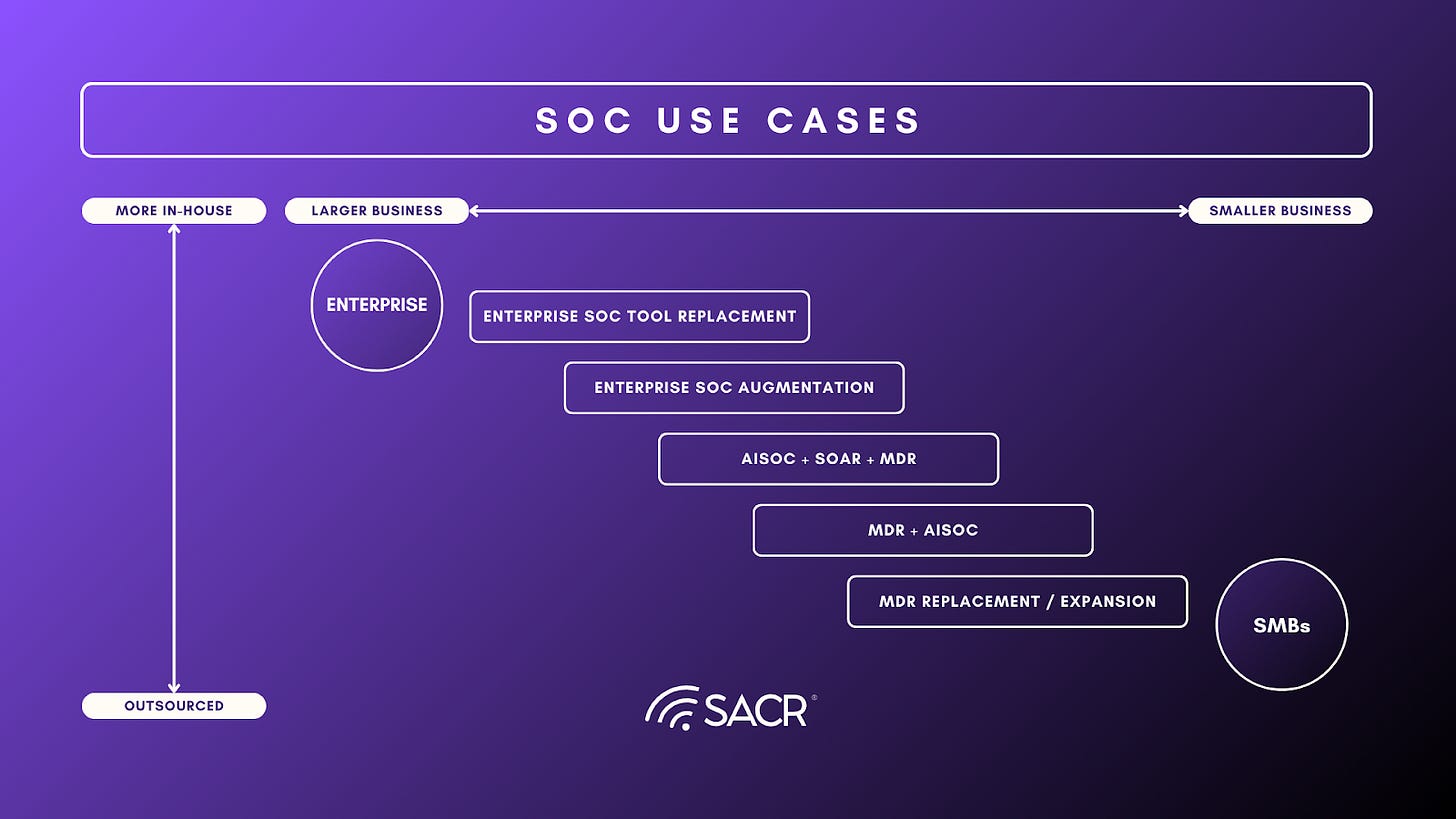
What often gets lost in discussions about AI SOC versus AI native MDR is that these are not opposing philosophies or competing futures. They are rational responses to where accountability lives inside an organization. Much of the debate assumes a single buyer profile and a single definition of readiness, when in reality security programs evolve as risk ownership shifts inwards. The divergence in AI SOC adoption is often explained as a function of technical maturity or organizational sophistication. The true dividing line is risk ownership. Enterprises and SMBs operate under fundamentally different constraints in how failure is absorbed, governed, or otherwise punished. As a result, they are rationally converging on different models for adopting AI in security operations.
Large Enterprises
Large enterprises do not approach agentic SOC technology as simply an opportunity for replacement. They approach it as a governance problem. These organizations already run staffed SOCs embedded within audit, compliance, insurance, and board oversight frameworks. In this environment, any system that investigates incidents or executes response actions inherits the same accountability burden as a human analyst. Autonomous decisions must be explainable, reversible, and defensible, often months later, under regulatory or legal scrutiny.
This makes broad autonomy structurally difficult to deploy, regardless of technical capability.
As a result, enterprises adopt AI primarily as an augmentation layer. Agentic capabilities are welcomed where they compress analyst workload, alert triage, enrichment, summarization, and guided workflows, but decision authority remains human. Even when autonomous response is technically viable, it is tightly gated behind approvals and policy constraints. The cost of an incorrect containment action inside a complex production environment is disproportionate to the marginal efficiency gains autonomy might deliver.
Crucially, this does not eliminate outsourcing. Most large organizations continue to externalize a meaningful portion of SOC coverage, particularly for 24/7 monitoring, surge capacity, and edge-case response. This persistence of MDR is not an indictment of tooling, rather, it reflects the economics of human availability and the practicality of transferring certain risk-bearing functions. In enterprise environments, agentic SOC platforms are evaluated as productivity tools, while accountability remains in-house or contractually shared with service providers.
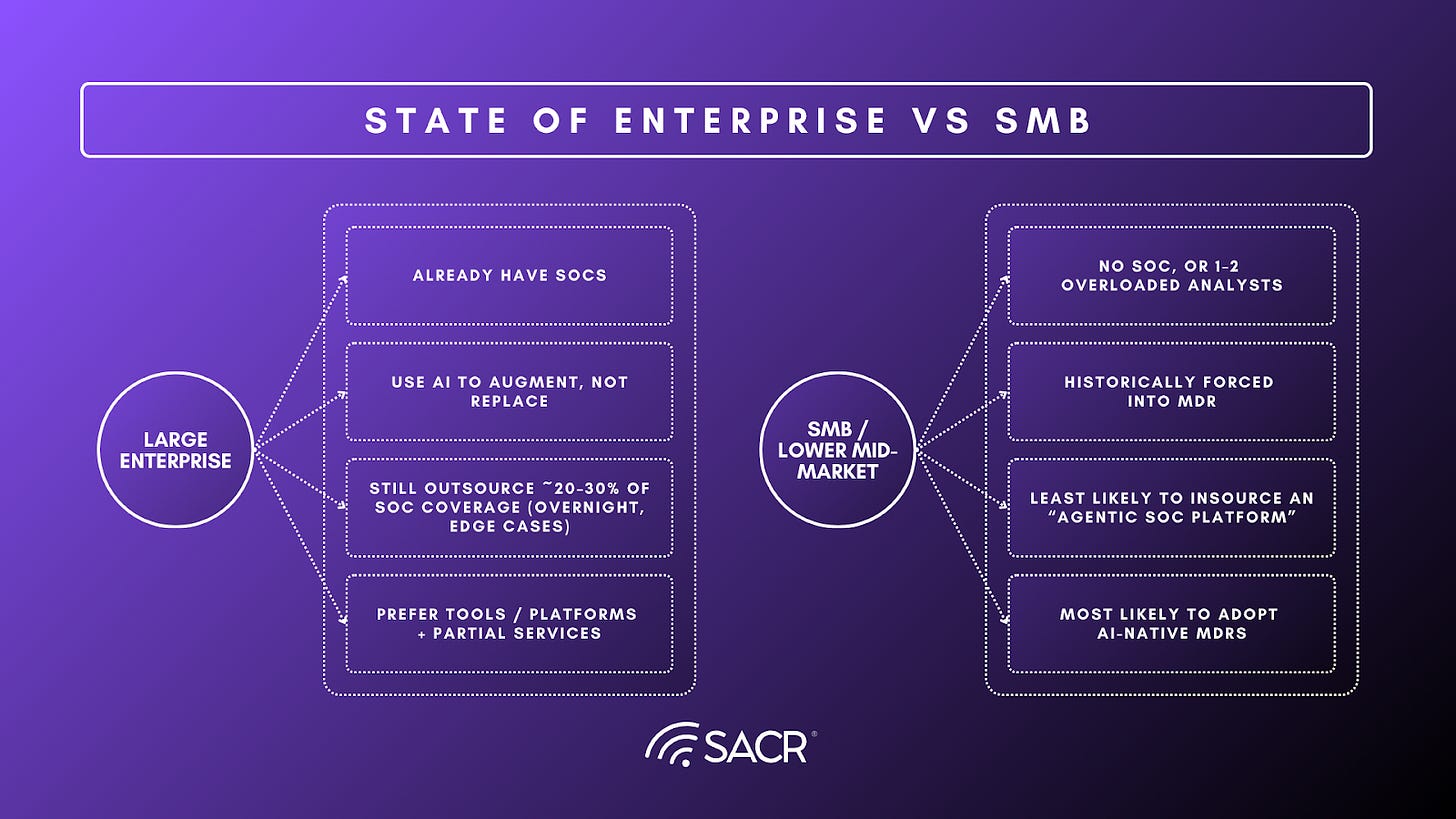
Large Enterprises
- Already have SOCs
- Use AI to augment, not replace
- Still outsource ~20–30% of SOC coverage (overnight, edge cases)
- Prefer tools / platforms + partial services
Mid-Market & SMBs
SMBs and mid-market organizations operate under a different set of constraints. Many lack the headcount, budget, or operational depth to staff a SOC at all. But more importantly, they lack the capacity to absorb the consequences of failure. A missed incident or a delayed response can be existential. For these buyers, the appeal of an “agentic SOC platform” is limited. Tools today still require supervision, tuning, and ownership of outcomes. That is precisely what these organizations are trying to avoid.
This is why AI-native MDR resonates so strongly in the mid-market. The defining value proposition is not autonomy; it is accountability transfer. When AI-driven investigation and response are delivered as a service, trust is mediated through the provider, not the model. Buyers are more willing to accept automation when responsibility for failure, operationally, contractually, and reputationally, sits outside their organization. In this context, AI is not replacing analysts; it is replacing the cost structure of service delivery.
Much of the public debate around whether “AI SOC is real” collapses these buyer realities into a single narrative. Enterprises questioning the safety of autonomous investigation are not invalidating AI-native MDR. SMBs adopting automation-heavy services are not endorsing fully autonomous SOC platforms. Each is responding rationally to its own risk profile and governance constraints. Treating these decisions as comparable leads to false conclusions about market readiness.
Most debates about “is AI SOC real?” fail because they collapse these categories into one.
The outcome is a durable split. Agentic SOC platforms will find adoption inside enterprises as constrained augmentation tools, bounded by governance and accountability requirements. AI-native MDR will gain traction where responsibility transfer matters more than architectural purity. This divergence is not a temporary phase. It is the natural consequence of how security risk is bought, managed, and blamed, and it will shape the SOC and MDR markets for years to come.
SMB / Lower Mid-Market
- No SOC, or 1–2 overloaded analysts
- Historically forced into MDR
- Least likely to insource an “agentic SOC platform”
- Most likely to adopt AI-native MDRs
Buyer’s Guide to finding the right platform for you
As AI driven security operations mature, buyers quickly realize that the real decision is not whether to use AI, but to apply it within their operating model. This is where many organizations take a pause. The choice between an AI-enabled SOC internally, and an AI-augmented MDR offering is not binary. It is contextual, shaped by maturity, risk tolerance, and realities of people, process, and business constraints.
Core Questions
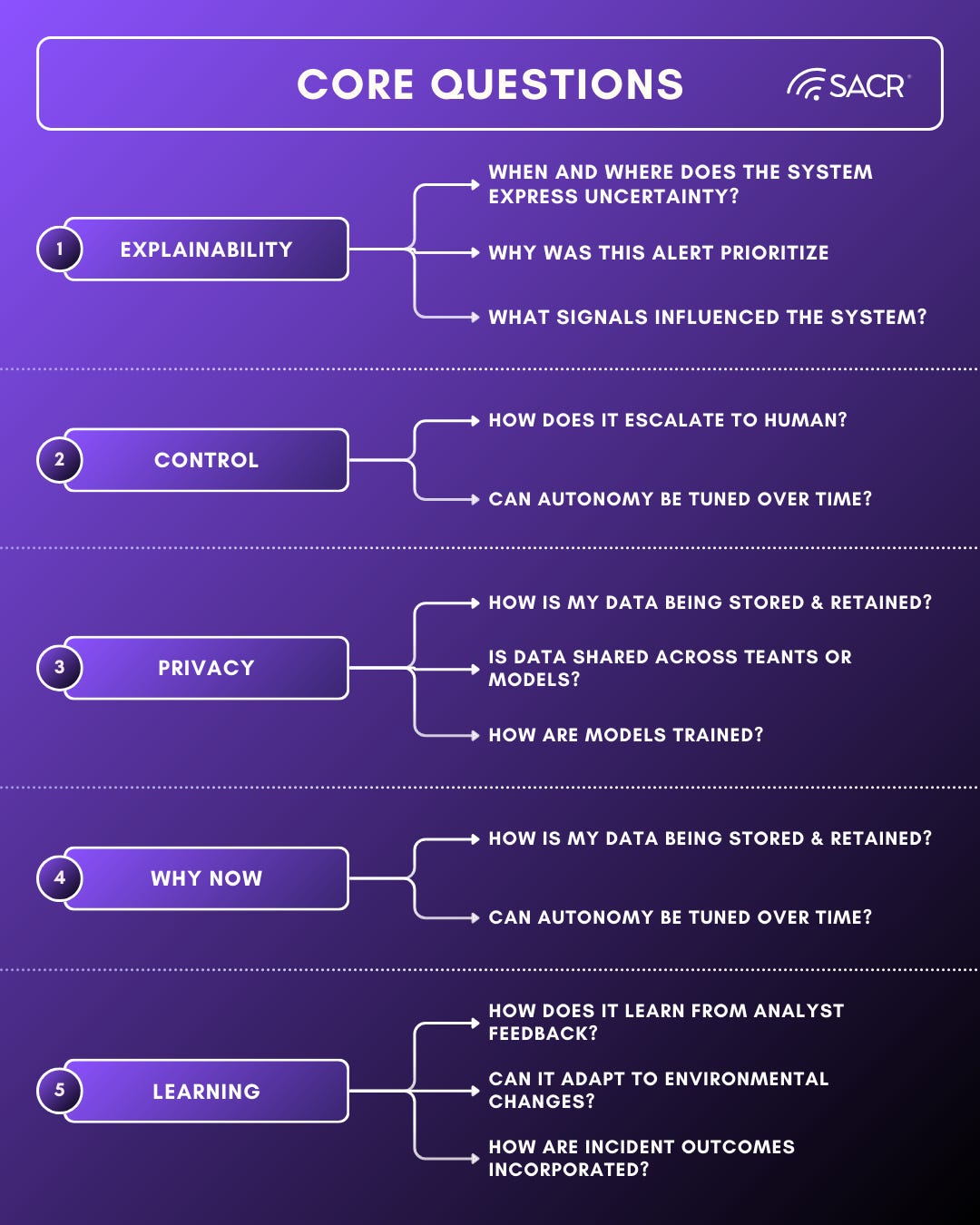
Before comparing vendors or delivery models, security professionals should anchor on a small set of foundational questions. These questions cut through feature lists and reveal whether a solution will actually improve outcomes.
The first question is how the system explains its reasoning. AI driven triage and recommendations must be interpretable. Practitioners need visibility into why an alert was prioritized, which signals mattered the most, and where uncertainty exists. Explainability is not a nice to have, it is the mechanism through which trust is built and maintained.
The second question is how much transparency and control the organization retains. Buyers should understand when AI is recommending, when it is acting, and when it is deferring to humans. Mature platforms allow teams to tune this balance over time as confidence grows, rather than locking them into rigid levels of autonomy.
Privacy and data handling form the third question. Security data is inherently sensitive. Organizations must understand how telemetry is stored, how long it is retained, where the data is stored, whether data is shared across tenants, and how models are trained. Clear boundaries are essential especially when introduced to regulated environments.
The fourth question is why this approach works now. Vendors should be able to articulate what has changed technically and operationally that enables better outcomes today than earlier automation attempts. Answers grounded in improved context ingestion, reasoning, and integration depth are far more meaningful than references to model sizing.
Finally, buyers should ask how the system improves over time. AI that does not learn from analyst feedback, environmental changes, and incident outcomes will stagnate program maturity. Continuous learning tied to real operational decisions is what differentiates an AI SOC from traditional correlation searches.
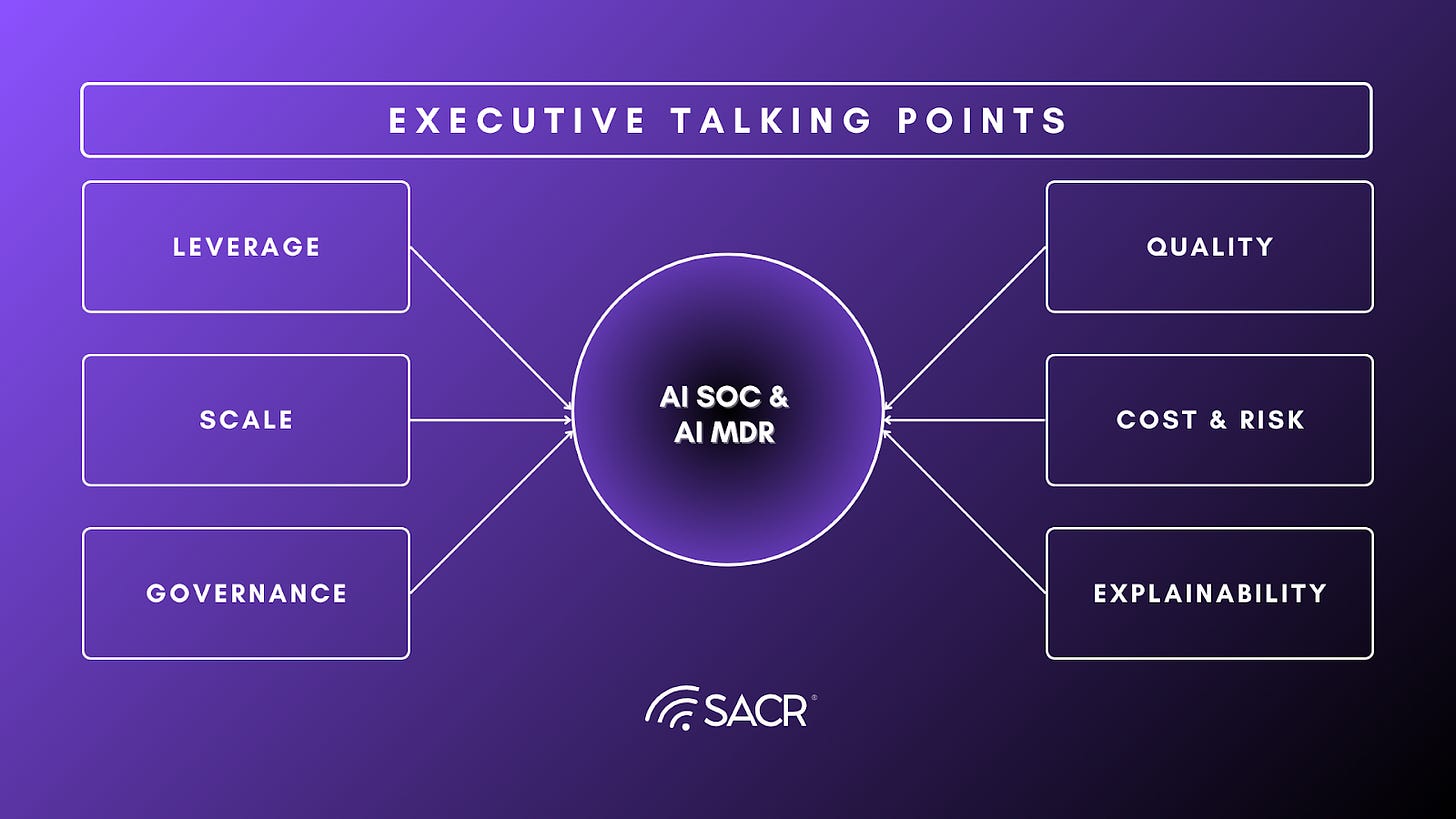
Board and Executive Talking Points on AI-Driven Security Operations
When discussing AI driven security operations with executives or boards, the conversation must move beyond tools and features. These talking points help anchor the discussion in outcomes and risk management.
- AI is about leverage, not replacement
- This is not a workforce reduction strategy. AI reduces manual overhead so highly skilled security professionals can focus on judgement, strategy, and resilience.
- We are buying decision quality, not speed
- Faster triage only matters if it leads to better outcomes. The value of AI lies in improved prioritization, clearer context, and more consistent decisions under pressure.
- Reduces long-term operational cost and risk
- Organizations already spend heavily on tool sprawl and reactive responses. AI driven operations improve efficiency while keeping knowledge and control within the organization.
- We maintain accountability and governance
- AI does not act autonomously without oversight. Humans remain accountable for containment, escalation, and business tradeoffs. Transparency and explainability are mandatory.
- This scales with the business
- As the organization grows, attack surface and complexity grow with it. AI allows security capability to scale without linear increases in headcount or burnout.
Vendors Analyzed for AI SOC powered AI MDR Capabilities
The following vendors offer AI SOC powered MDR services and were analyzed deeply for their technical capabilities and business use cases, via product deep dives, multiple briefings, questionnaires and customer interviews.
24/7 MDR Service Delivery at Scale
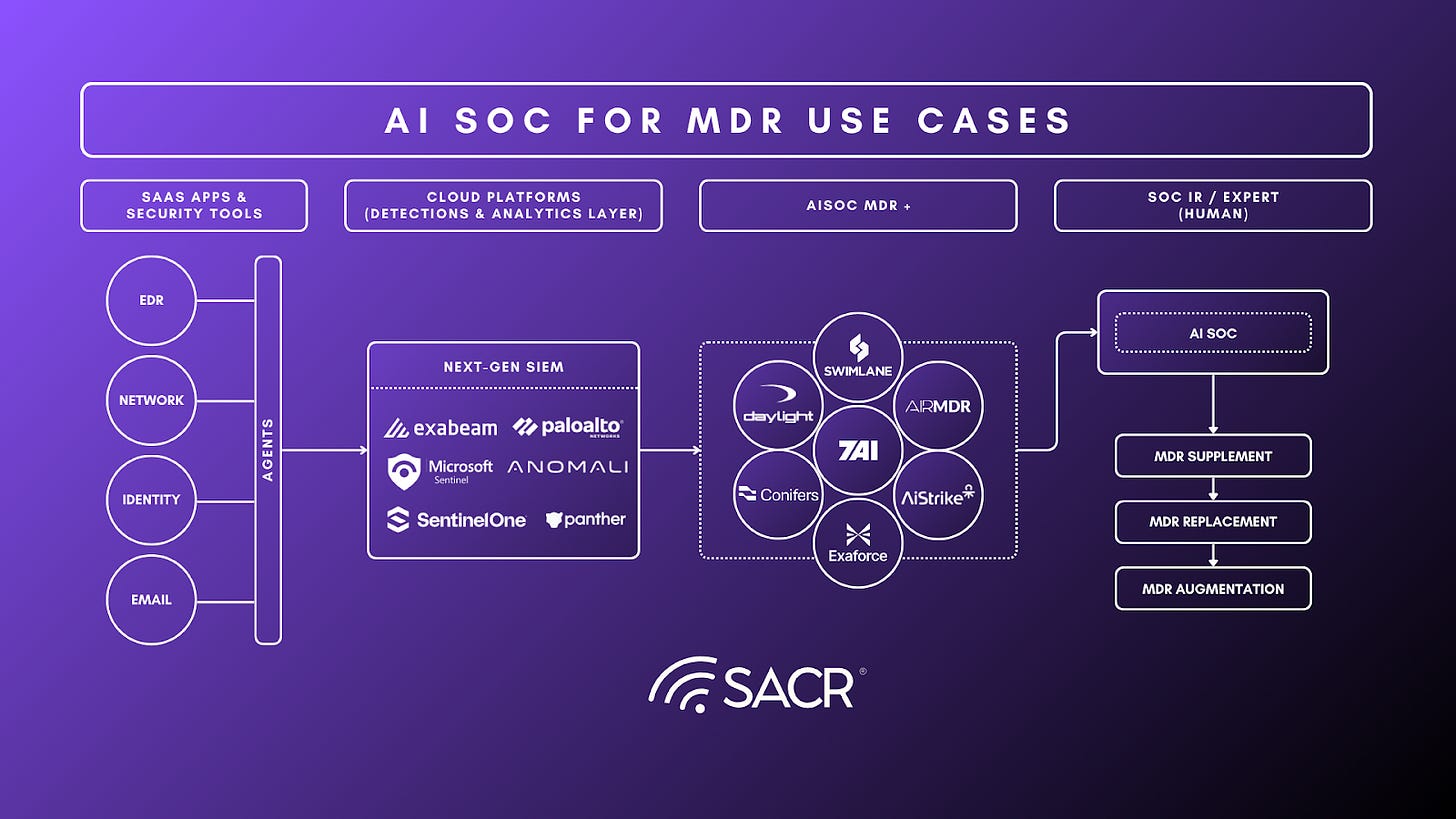
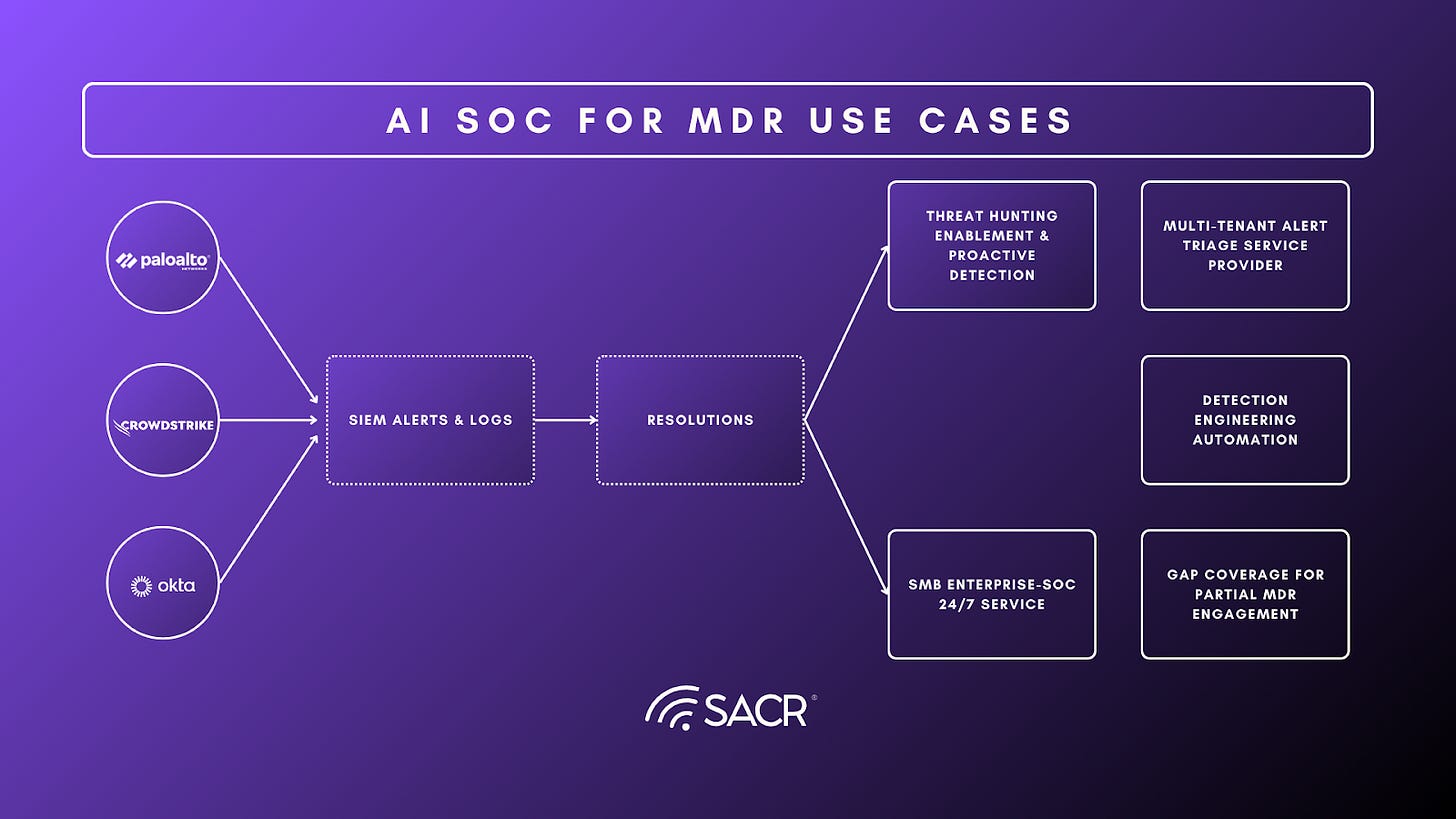
AISOC-powered MDR enables true 24/7 coverage, scaling analyst capacity and delivering consistent outcomes without human fatigue. To further evaluate innovation in this industry, we did a deep dive into the following 7 vendors with deep dive demos, questionnaires and customer interviews. Here are some highlights –
7AI: Supports 24/7 MDR service delivery with automated escalation, auto-response to high-priority incidents, and external support teams for additional context. Customers can assign cases directly to 7AI, which is building out full 24/7 service offerings for MDR replacement.
AirMDR: Delivers 24/7 MDR with AI-native analysts handling the vast majority of alerts. Only 3% of cases require human touch, allowing for massive scaling of coverage and improved SLA times. AI-driven MDR is more cost-effective and consistent than traditional human-led approaches.
AiStrike: Delivers Agentic Cyber Defense as a Service, which replaces traditional MDR by using AI-driven agents to continuously detect, investigate, and respond to threats while operating, tuning, and optimizing defenses without requiring organizations to manage another tool.
Conifers AI: Multi-tenancy and predictable pricing models make Conifers suitable for MSSPs and organizations seeking to scale MDR delivery. The platform’s agentic AI continuously adapts to new environments, supporting high-volume, multi-tenant operations.
Daylight Security: Employs a follow-the-sun expert team model (US, Singapore, Tel Aviv) and claims to support higher customer-to-analyst ratios than previously possible. The hybrid automation-services model enables Daylight to deliver premium, scalable MDR with rapid investigation and zero open threats for key customers.
Exaforce: Provides both self-managed and fully managed MDR options with 24/7 coverage. Customers can automate as much as possible, or leverage Exaforce’s MDR for full coverage, with the platform supporting both approaches depending on organizational needs.
Swimlane: The Turbine platform is proven at scale, supporting thousands of daily users and billions of automated actions monthly. Swimlane’s architecture enables predictable, extensible, and resilient MDR service delivery, with multi-tenancy and role-based access control for large-scale operations.
Alert Triage & Investigation Automation
AISOC platforms have transformed alert triage and investigation, reducing analyst workload, improving consistency, and accelerating response.
7AI: Automates enrichment from all sources into tickets, enabling faster investigation and response without additional headcount. 7AI can handle full investigations and conclusions for selected or all use cases, supporting both in-house SOCs and MDR overlays. The platform enables automated triage, prioritization, and escalation, with support for high-value response actions and oversight by internal teams when desired.
AirMDR: Uses AI virtual analysts to automate 80–90% of alert triage, investigation, and response. Automated playbooks execute in under 5 minutes compared to over an hour for human analysts. NLP-driven capabilities allow the system to answer questions, learn facts, and document incidents with transparency, supporting comprehensive remediation and learning.
AiStrike: Automates alert triage by grouping related alerts based on MITRE framework patterns and repeatability, applying behavioral context and organizational policies to filter noise and surface high-risk threats from toxic alert combinations.
Conifers AI: Delivers automated triage and investigation through tool-using agents that operate step-by-step, rather than as monolithic models. Conifers integrates directly with SIEM, EDR, and ITSM tools (e.g., ServiceNow, Jira), embedding its findings into existing workflows. The platform’s “Cognitive First Analysis” provides consistent, well-informed triage decisions and recommendations directly within analysts’ current workbenches.
Daylight Security: Features a streaming detection pipeline and agentic investigation platform (AIR) that can correlate alerts across cloud, endpoint, and identity sources in under a minute. The system leverages a knowledge graph for business context and supports fully automated, agentic investigations across multiple channels (Slack, Teams, Email), significantly reducing investigation times.
Exaforce: Exabots (AI agents) perform triage, investigation, and response. The multi-model AI engine pre-processes data to build behavioral baselines and peer comparisons, enabling the system to triage alerts and conduct investigations at scale. Exaforce claims a 10x improvement in SOC productivity and efficacy, with the ability to perform investigations like a Tier 3 analyst.
Swimlane: Swimlane’s Turbine platform leverages deep agents and proprietary AI to ingest, build, and execute security investigations for both known and unknown alerts. Agents can build playbooks from natural language, provide recommendations, and execute actions with full traceability and auditability. The platform’s low-code interface enables rapid creation of security applications and workflows.
Threat Detection Across Multiple Signal Sources
AISOC platforms ingest and correlate data from diverse sources EDR, SIEM, cloud, identity, and network to detect sophisticated threats.
7AI: Supports automated enrichment from all sources, integrating with existing detection and response pipelines. The platform can be deployed alongside MDR providers to cover additional use cases not handled by legacy MDRs, such as cloud or identity-focused threats.
AirMDR: Delivers more than 200 out-of-the-box integrations 40–50% more than typical MDR providers. AirMDR’s virtual analysts can ingest and correlate signals across cloud, endpoint, and identity, supporting rapid and comprehensive threat detection.
AiStrike: Integrates with existing detection sources like SIEM and EDR while providing its own detection coverage for gaps such as newly discovered threats or SaaS data sources, delivering detection as code that can be deployed directly on decentralized data stores.
Conifers AI: Integrates with SIEM, EDR, cloud security, and identity platforms, creating a semantic layer for interactive data exploration and threat hunting. The platform’s continuous learning adapts to each customer’s environment for context-aware detection.
Daylight Security: The AIR platform’s streaming detection pipeline ingests and correlates signals from EC2, CloudTrail, IDP, threat intelligence, ZTNA, and EDR, supporting multi-source detection and rapid investigation. The knowledge graph further enriches context for detection.
Exaforce: Goes beyond typical SOAR integrations by ingesting events, configs, identity data, and code artifacts from platforms like AWS, GitHub, Azure, and Google Workspace. Exaforce provides out-of-the-box behavior-based detections in addition to those ingested from SIEM and EDR, supporting comprehensive multi-signal detection.
Swimlane: Offers thousands of integrations (5,000+ third-party actions) and an autoscaling automation engine, supporting high-velocity data ingestion and action execution. Swimlane’s platform is built to process billions of automated actions monthly, supporting multi-signal detection at scale.
Automated Response & Remediation
AISOC platforms orchestrate and execute containment, isolation, eradication, and remediation actions with minimal human intervention.
7AI: Supports automated remediation with configurable thresholds for auto-action vs. recommendations, based on customer risk tolerance. Can auto-respond to high-priority items, escalate via modern equivalents of call trees, and integrate with customer remediation workflows.
AirMDR: Automated playbooks for response and containment execute in under 5 minutes, with full transparency and documentation. The system supports comprehensive remediation and learning, reducing mean time to respond (MTTR) and improving incident outcomes.
AiStrike: Provides built-in SOAR capabilities and case management to execute automated response actions, while also supporting integration with external SOAR platforms like Torq for workflow automation.
Conifers AI: Provides recommended response steps based on investigation findings, integrated directly into existing case management systems. Conifers can trigger customer-approved remediation workflows in SOAR, Sentinel, or ServiceNow, supporting both automated and human-in-the-loop response actions.
Daylight Security: The AIR platform enables agentic, context-aware response actions, including containment and remediation across multiple channels. The system’s integration with business context ensures that remediation is aligned with organizational policies and priorities.
Exaforce: Exabot Respond enables teams to build response actions through natural language, reducing the need for complex SOAR engineering. Automated containment and response actions are executed in minutes, with a human-in-the-loop model for high-impact decisions. The platform also supports custom automation agents for complex remediation workflows.
Swimlane: Provides deterministic automation of response and remediation actions, with AI agents executing playbooks reliably and immediately. Human-in-the-loop approval is supported for critical actions, ensuring transparency and auditability. The platform’s automation fabric guarantees reliable, large-scale execution of remediation workflows.
In-Depth Vendor Insights
7AI
7AI provides a security operations platform designed around AI-native investigation workflows. The platform integrates with a wide range of security controls and ingests detection events from email, identity, endpoint, cloud, and network sources. AI agents within the system automatically categorize, correlate, and investigate alerts, while maintaining detailed visibility into each agent invoked, mission executed, artifacts analyzed, and tools used during investigations. The platform can be deployed as a self-service solution with standard business hours support or through PLAID Plus, a 24/7 managed service offering. This flexibility allows the platform to serve large enterprises with internal SOCs, mid-market teams seeking selective automation, and organizations considering a full replacement of traditional managed detection and response (MDR) services.
Voice of the Customer
We were able to interview a customer of 7AI who shared their experience with 7AI with us, here is what they said –
Life before 7AI
Before 7AI, the organization’s security operations struggled with alert overload and manual triage. The team received constant alerts, over 98 percent of which required no action, but critical alerts triggered time-consuming manual correlation across related low- and medium-priority events. Relying on MDRs created a cycle of switching providers every one to two years without resolving the core issues. Generic detection rules from public sources like Sigma failed to account for the organization’s specific environment, producing high false positives and limiting detection scope. This left massive alert backlogs uninvestigated, exposing a technology gap where people and processes alone could not scale incident response effectively.
“I’m flooded with alerts from critical to informational alerts. About 98% of the alerts don’t need action. It’s just telemetry, it’s noise. And so the hardest part was, is that, Great, you have a critical alert that went off, but there’s other low and medium alerts that went off for that same host. So I have to go manually go check through everything and close off those alerts associated with that core alert that woke me up in the middle of the night to go investigate.”
Core Use Cases that they use 7AI for
The customer uses 7AI to handle the complete lifecycle of alert investigation at scale. The platform investigates every alert that comes in, which eliminates the backlog problem the team faced when doing manual triage. 7AI delivers investigation verdicts about 30 minutes faster than their previous MDR could escalate cases. Most importantly, it learns their specific environment and applies that context to accurately identify false positives that their MDR kept flagging incorrectly, even after the team repeatedly told the MDR to ignore certain patterns.
“I was putting 7AI up against MDRs, and 7AI got me the result, the verdict, about 30 minutes faster than MDR could ever escalate to me.”
“And about every case that we had from our MDR, 7AI already investigated it, enriched it, used our context from our environment that we kept telling our MDR, if you see this, ignore it. This is a false positive. They refused. But 7AI was able to say, This is a false positive and here’s why from this environmental context provided by this analyst.”
What they would like to see on roadmap
The customer wants the platform to see more focus on “response” execution. They highlighted that the platform already performs well in collecting telemetry, enriching alerts, and correlating events automatically. The next step would be to see a co-pilot approach for escalated cases, where AI proposes actions aligned with organizational policies and allows analysts to respond using natural language. This marks a shift from traditional static runbooks to adaptive, learning workflows. The customer emphasized that this approach could provide a fully end-to-end solution, handling triage through remediation within a single platform.
“Collecting all the telemetry, enriching, doing all the correlation. But the next step is the fundamental shift of how we do remediation. Essentially looking at more of a co-pilot where I have a case that has now been escalated to where I need to do some action. And I want some natural language processing to say, Here’s the agents like I have this case.”
Company Vision
The founding team identified a gap in security operations scalability. Traditional MDRs offer limited visibility, while SOAR platforms demand engineering resources many teams cannot sustain. Large organizations struggle with rising alert volumes, and smaller teams often lack the expertise to manage modern SOC tools. 7AI addresses this through a platform-and-service model that provides forensic-level transparency and allows teams to control which tasks are automated versus analyst-driven..
Architecture and Deployment Maturity
They mention Hybrid deployment model. Specific details are unknown.
Data Collection and Ingestion Methods
The platform consumes detection events and pulls contextual data needed for investigations.
- SIEM integrations: Detection events and alerts from existing SIEM deployments feed into the investigation workflow
- EDR platforms: Endpoint detection and response alerts
- Email security: Email security tools
- Identity systems: Authentication logs, and access activity from identity providers
- Cloud platforms: AWS, Azure, GCP audit logs
- SaaS applications: Google Workspace, Okta, and other SaaS platforms for user activity and access patterns
- Network security: Network logs and traffic analysis
- Threat intelligence: External threat intelligence sources
- ITSM platforms: JIRA and custom ticketing platforms for result delivery and case management
Additional Integrations are built on demand. The team reports <1 week per integration.
Capabilities
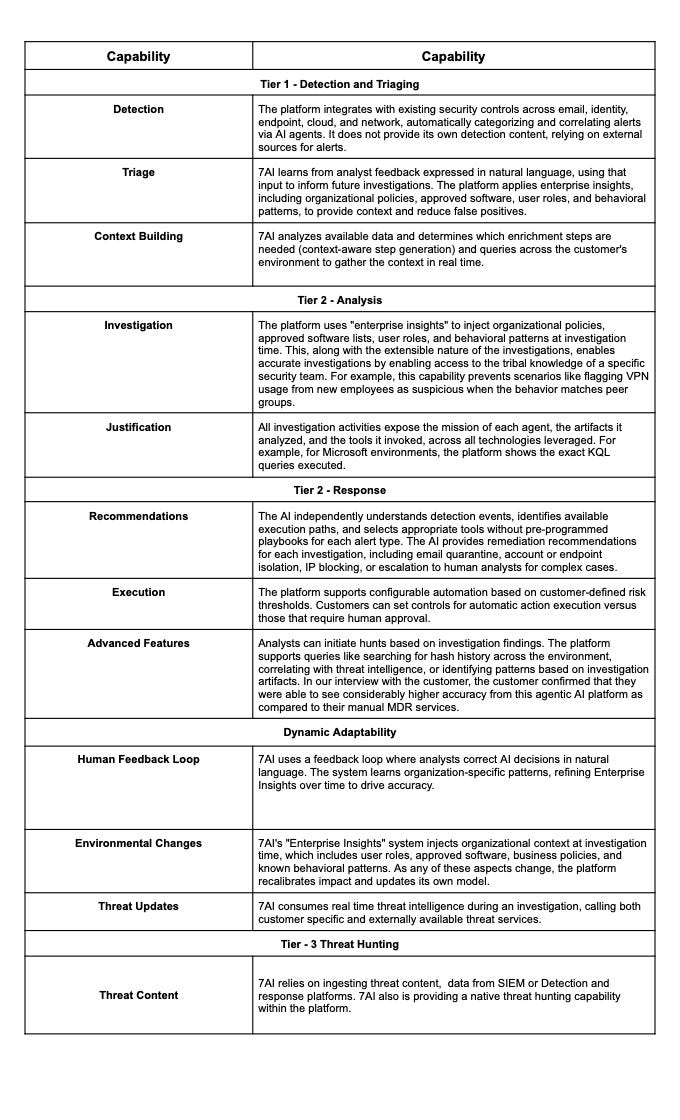
7AI delivers automated investigations across the complete security operations lifecycle. The platform consumes detection events, executes investigation workflows, draws conclusions with transparent reasoning, and either recommends or executes remediation actions based on customer-defined risk thresholds.
Agentic SOC / MDR Capability Matrix
AI Guardrails and Explainability
As we move into the AI SOC world, its important to note the different ways vendors address security and privacy concerns. Here’s how 7AI protects and maintains privacy of customer information.
Data Privacy and Security:
7AI’s architecture processes data where it already resides, including SIEMs, EDRs, identity, cloud, and network systems, without centralizing it in a data lake by pulling it via API calls. The platform uses pre-trained foundation models from OpenAI and Anthropic and does not use customer data for training. Organizational context is dynamically injected at investigation time using Retrieval-Augmented Generation. Each tenant operates in a logically separated environment on AWS with encryption in transit and at rest. Credentials are never exposed to the AI. Access is controlled with role-based permissions, least-privilege API keys, multi-factor authentication, and SSO. The system also applies input verification and hallucination detection before any data reaches the models.
Explainability:
7AI provides full transparency for every investigation. Each case includes which agents were deployed, the tools and data accessed, the reasoning from evidence to conclusion, queries executed, artifact relationships, and recommended actions. A centralized audit log captures all AI activity across the environment. Analysts can review and validate every step, building trust in the system. Feedback from analysts is used to refine organizational context and adjust behavior for future investigations, creating a continuous learning loop without altering the base model.
Analyst Take
Here’s what we see as top 3 strengths that 7AI provides
PLAID Service Model
7AI’s People-Led AI-Driven approach pairs AI agents with human Security Engineers who continuously tune workflows, manage false positives, and optimize investigations. This hybrid model removes the burden of prompt engineering and SOC management from internal teams and makes autonomous investigation accurate and viable for risk-averse organizations. The PLAID Plus tier adds 24/7 human support, providing a safety net for enterprises adopting AI-driven investigations.
Secure, Minimal-Footprint Architecture
7AI queries data in place via APIs, avoiding central log ingestion and minimizing exposure. It uses pre-trained OpenAI and Anthropic models without customer data training, injecting organizational context dynamically with Retrieval-Augmented Generation. Multi-tenant isolation, end-to-end encryption, least-privilege access, and external credential management ensure data security, while input verification and hallucination detection reduce the risk of unreliable conclusions.
Zero Customer Data Training with RAG-Based Context Injection
7AI uses pre-trained foundation models from OpenAI and Anthropic under enterprise agreements that prevent any training on customer data. Organizational context is applied at investigation time using Retrieval-Augmented Generation. This approach protects data sovereignty while allowing the AI to understand company-specific nuances such as approved tools, identity conventions, and acceptable risk thresholds through the Enterprise Insights feedback loop.
Areas to Watch
Querying data via API where it lives is a plus on footprint, but it means 7AI’s investigation depth is limited by what your existing tools expose through their APIs. For example, If your EDR doesn’t surface certain telemetry through its API, or your SIEM’s query language limits what can be retrieved programmatically, the AI agents can’t access that context. This is an architectural trade-off. The platform’s approach to external threat intelligence feeds remains unclear from available documentation.
The feedback loop currently applies most strongly to investigation and triage decisions. Organizations are still building trust around autonomous remediation, so most feedback on response actions focuses on refining recommendations rather than correcting fully autonomous executions, which is emerging. As customers become more comfortable, 7AI expects the feedback loop will expand to cover response actions more comprehensively.
AiStrike
AiStrike was founded by members of the original Securonix founding team after observing that security operations do not scale with human effort. The platform uses a multi-agent architecture built on RAG (Retrieval-Augmented Generation) and KGAG (Knowledge-Graph Augmented Generation) to support accurate and explainable analysis. Multiple agents are designed for specific tasks such as detection, investigation, response, alert grouping and correlation, emerging threat identification, workflow coordination and response automation, all managed through a central orchestration layer. Each agent has a defined role and analyzes live telemetry and alerts, enriched entity data covering users, assets, identities, and vulnerabilities, along with threat intelligence and historical cases. Agents use built-in tools such as queries, playbooks, and system integrations to collect evidence, test assumptions, and verify results before recommending and taking actions, aligning automated reasoning with analyst workflows.
AiStrike also evaluates existing detection rules to determine how they perform in real environments, automatically tuning noisy or incorrect logic and generating new detections when coverage is missing. The platform measures detection coverage by mapping existing rules to frameworks such as MITRE ATT&CK and identifying specific gaps. It correlates relevant threat intelligence with internal telemetry to determine which adversary techniques matter for a given environment and generates detections for those techniques. The company also provides 24×7×365 Managed Cyber Defense Service – for full managed detection and response service.
Voice of the Customer
Prior to adopting AiStrike, the customer relied on a traditional MDR provider for Tier 1 alert triage and detection engineering. This model proved increasingly inefficient and costly in a complex hybrid environment. A significant portion of alerts escalated to the internal Tier 2/3 team, creating alert fatigue and limiting the team’s ability to focus on higher-value investigations. Many escalations lacked actionable context or were repeat false positives, while detection tuning and new detection development delivered limited value. The MDR service also showed integration gaps, including lack of native workflows with tools such as Slack, ServiceNow, Wiz, and other cloud security controls, reducing operational efficiency and visibility.
Company Vision
AiStrike’s vision centers on eliminating the human scalability bottleneck with the help of AI for modern security operations. The founding team, which came from Securonix, observed that even with mature SIEM and SOAR platforms, organizations still struggled with four systemic problems: detection engineering that doesn’t scale beyond manual rule creation, alert volumes that grow faster than teams can handle, SOAR playbooks that remain static while threats evolve, and centralized architectures that create operational inefficiency in distributed cloud environments. Their founding thesis is to replace static, human-engineered workflows with a self-improving, federated, agentic AI SOC architecture.
Architecture and Deployment Maturity
AiStrike supports SaaS, bring-your-own-cloud deployments, and hybrid models – a SaaS application with on-premises forwarders.
Data Collection and Ingestion Methods
The platform consumes detection events, environment context and Threat Intelligence data needed for investigations.
- SIEM integrations: Detection events and alerts from existing SIEM deployments feed into the investigation workflow
- EDR platforms: Endpoint detection and response alerts
- Cloud platforms: AWS, Azure, GCP audit logs
- SaaS applications: Google Workspace, Okta, and other SaaS platforms for user activity and access patterns
- Network security: Network logs and traffic analysis
- Threat intelligence: External threat intelligence sources like Intel45, NVD, VirusTotal
- ITSM platforms: JIRA and custom ticketing platforms for result delivery and case management
- SOAR platforms: Like Torq
Capabilities
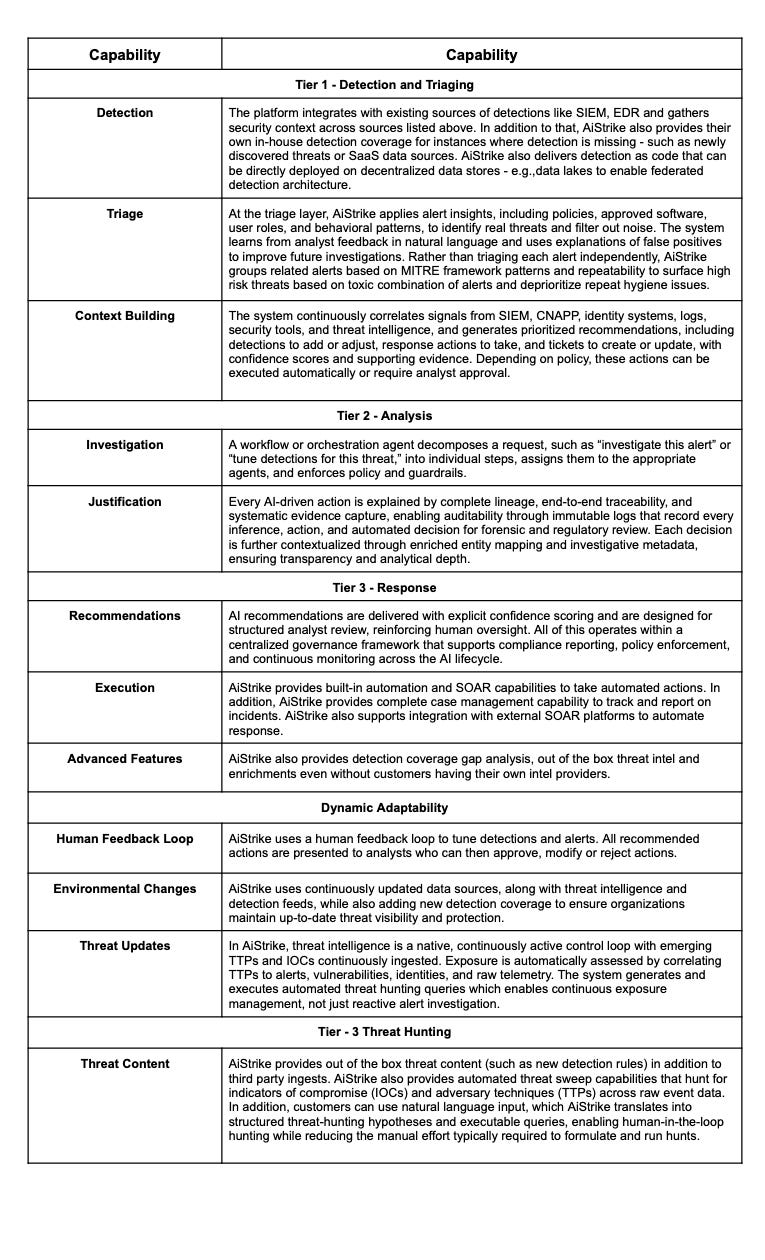
AiStrike supports the full SOC lifecycle using a closed-loop learning model. The platform improves detection engineering over time, turns threat intelligence into usable detections, and automates threat hunting. It supports investigations by identifying root causes and executes response actions through integrated case management.
Agentic SOC / MDR Capability Matrix
AI Guardrails and Explainability
As we move into the AI SOC world, it’s important to note the different ways vendors address security and privacy concerns. Here’s how AiStrike protects and maintains privacy of customer information.
Data Privacy and Security:
AIStrike limits AI access to only the data needed for each task, with sensitive information protected through redaction, anonymization, and tokenization, including PII and PHI. Data is processed only for the duration of the inference and is discarded immediately, with no long-term storage. The system includes protections against prompt injection, jailbreak attempts, adversarial input manipulation, and model misuse. To reduce the risk of incorrect outputs, AI responses are grounded in trusted sources such as enterprise knowledge bases, contextual data, threat intelligence, and standard operating procedures. The platform enforces strict tenant isolation to prevent any cross-customer data exposure and uses encryption in transit and at rest with TLS and AES-256. Customer data is not used to train foundation models by default. They are certified by SOC 2 Type II, ISO 27001, ISO 27701, ISO 42001, NIST 800-53. AiStrike is SOC 2 Type II certified and is pursuing FedRAMP authorization to support government sector customers.
Explainability:
AIStrike provides full transparency for every investigation with justification steps, sources and context. Every AI action is recorded with full lineage, clear traceability, and supporting evidence to explain how decisions are made. The platform maintains immutable audit logs that capture each inference, action, and automated decision, enabling forensic analysis and compliance review.
Analyst Take
Here’s what we see as top 3 strengths that AiStrike provides
Threat Detection Depth
AiStrike shows strong technical depth in threat detection by using a multi-agent AI approach. The platform correlates signals from multiple stages of an attack and across third-party tools such as GuardDuty, CrowdStrike, and Okta,similar to other AI SOC platforms but what differentiates them with a lot of others is that they also generate native detections to close gaps that existing tools often miss. Its threat exposure management continuously tracks emerging threats and maps them to specific assets in the customer environment, giving security teams early, context-rich insight into how new attack techniques could impact them.
Self-Improving Detection Engineering That Addresses Coverage Gaps at the Source
The platform evaluates existing detection rules to determine how they perform in real environments, automatically tunes noisy or incorrect logic, and generates new detections when coverage is missing. It measures detection coverage by mapping existing rules to frameworks like MITRE ATT&CK and identifying specific gaps. Rather than simply deploying thousands of new rules, AiStrike focuses on improving detection quality and reducing false positives at the source.
Zero-Trust AI Architecture with Explainability Built In
Their deployment flexibility along with security certifications listed can help security leaders in regulated industries have more assurance. The platform performs data preparation ahead of using it with AI. Pre-AI sanitization includes data redaction, anonymization, and tokenization to protect sensitive data. Data is processed transiently and discarded immediately after inference with no long-term storage. The platform includes adversarial hardening to defend against prompt injection, jailbreak attempts, adversarial input manipulation, and model misuse.
Areas to Watch
AIStrike is playing in multiple categories (SOC automation,, threat exposure automation) and their marketing strategy could struggle with a single clearly defined positioning around SOC automation. AiStrike’s “Service-as-Software” positioning is conceptually interesting but operationally Security leaders may need clarity on whether AiStrike competes on cost, capability depth, or deployment speed, and which buyer persona and budget line item they’re targeting. The current positioning risks being “a little bit of everything” without being focussed in a specific dimension that drives purchasing decisions. The platform profiles entities and flags anomalies, but there’s no indication of multi-dimensional behavioral modeling that accounts for role-based patterns, time-based patterns, peer group comparisons, or resource-specific norms.
AirMDR
AirMDR tackles SOC operations through two core offerings. One, from a platform perspective, enterprises can use the AI SOC capabilities that AirMDR provides. As with any product, the end user of the platform is the SOC team within the enterprise buying the platform. But AirMDR does not stop there. As their name suggests, they place a heavy focus on providing AI led MDR services to enterprises that do not want to deal with the heavy lifting of SOC operations. In the latter case, AI powered SOC agents are managed by AirMDR’s team of experts that provide 24/7 SOC services.
The idea for the company evolved from the founders’ experiences with earlier SOAR-based approaches. The founding team recognized that traditional SOAR platforms required significant investment and specialized expertise to operate effectively. They shifted their focus to building an AI native architecture that makes automation accessible without the need for deep SOAR engineering skills. One differentiator in their GTM strategy is their “Test before you buy” concept with MDR services – something that is traditionally not an option. AirMDR runs POVs in 80% of their deals. The remaining 20% get a 60-day out clause with no questions asked. This stands in contrast to the MDR industry norm where vendors rarely offer trials before purchase.
Voice of the Customer
The following are based on customer testimonial –
Life before AirMDR
- They were handling detection and response completely in-house with a very small security team, and it was obvious that model wouldn’t scale with the company or give them the level of coverage they needed. Building and running their own SOC would have been time-consuming, expensive, and not a core focus of the business.
Core Use Cases that they use AirMDR for
- 24×7 coverage and triage: Uses AirMDR as an always-on detection and response tier that monitors alerts around the clock, triages them, and only escalates what truly matters.
- Transparent, reviewable investigations: Relies on AirMDR to show every alert, investigation step, and data source so the team can audit quality instead of treating MDR as a black box.
- High-confidence escalations: Uses AirMDR cases as a decision accelerator, allowing the team to quickly review, trust the analysis, and move straight to remediation or handoff to engineering.
- AI-driven investigations they can trust: Leverages AirMDR’s AI to handle first-line triage and investigation in a way that is explainable and reviewable, rather than hype-driven.
- Scalable cloud-native security program: Treats AirMDR as a plug-in MDR for their cloud-native stack, enabling them to scale security operations without building a large 24×7 SOC in-house.
What they would like to see on roadmap
- They want AirMDR to continue deepening its AI-driven investigations and automation – ideally achieving Level 3 analyst quality versus today’s L1/L2 quality.
Company Vision
The company’s vision is to make Fortune 500 grade SOC accessible to every organization, specifically for SMBs (Small to Mid Size Businesses) that may not have the budget or manpower to invest in highly skilled SOC analysts and operations. To execute on this vision, AirMDR leverages agentic AI capabilities that are powered by a strong data and explainability core to maintain the accuracy, speed, and quality of tier 1 and tier 2 analyst operations. They aim to close the compromise between quality and cost, often centered around human effort alone and manual Managed Detection and Response services in SOC.
Architecture and Deployment Maturity
AirMDR supports SaaS-only deployment. The platform also offers an optional remote agent (launched in Jan) for on-prem collection and response, but does not offer a fully on-premises (self-hosted) option.
Data Collection and Ingestion Methods
AirMDR integrates with diverse set of data sources, taking into account customer maturity and infrastructure:
- SaaS platforms: SaaS applications such as Okta, Azure, others. Integration particularly useful for small enterprises that often parse raw telemetry from such applications without using a centralized SIEM
- SIEM integration: Teams with existing SIEM deployments can integrate detection rules and raw log data
- Endpoint data: EDR platforms that provide host-level telemetry
- Network data: Network traffic logs and VPC flow logs
- Cloud audit logs: AWS CloudTrail, Azure Activity Logs, and GCP Audit Logs
- Email security: Phishing detection signals and email threat intelligence
- Identity systems: Authentication and access activity from identity providers
The platform offers several integrations out of the box, and offers a way to create custom integrations making POCs easier. The company states this as a competitive advantage with a broader coverage than many MDR solutions and aligns with the majority of common customer integration needs.
Capabilities
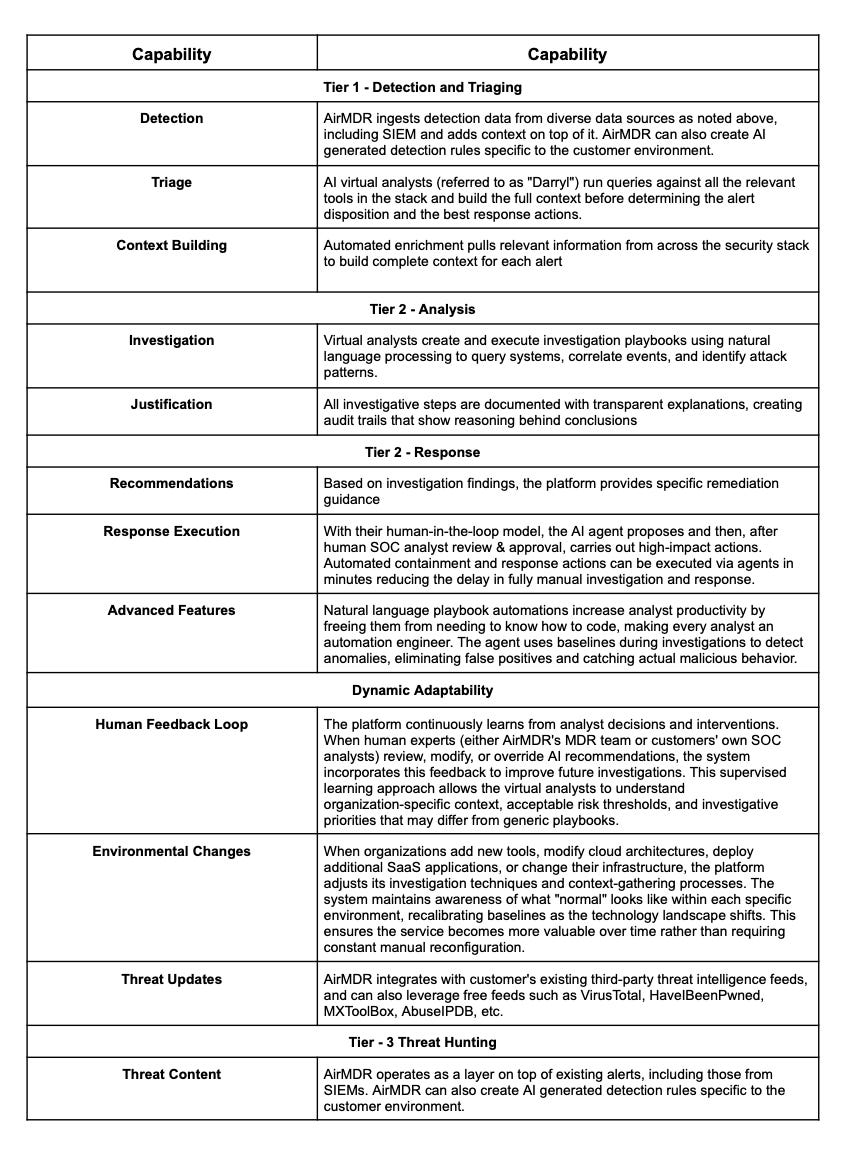
AirMDR’s AI Powered MDR services are aimed to alleviate SOC burden, without requiring customers to build or staff SOC analysts themselves.
Agentic SOC / MDR Capability Matrix
AI Guardrails and Explainability
As we move into the AI SOC world, it’s important to note the different ways vendors address security and privacy concerns. Here’s how AirMDR protects and maintains privacy of customer information.
Data Privacy and Security:
AirMDR encrypts all data at rest and in transit. The company reports that it maintains commercial agreements with public AI model providers to ensure customer data is not used for model training outside the customer’s own environment.
Explainability:
Transparency is positioned as a central component of both the AI MDR service and the AI SOC Agent. The platform provides detailed case outputs with explanations for each investigation. Additional context and reasoning can be accessed through natural language interaction with the virtual analyst, enabling security teams to understand how conclusions were reached. This supports trust, accelerates validation, and facilitates compliance reviews. All incidents are consistently documented, substantiated, and processed with full transparency for comprehensive remediation and organizational learning.
Analyst Take
Here’s what we see as top 3 strengths that AirMDR provides
Dual Go-to-Market Model
AirMDR operates a dual model that includes both an AI MDR service and an AI SOC platform, offering flexibility not typically seen among single-model providers. Organizations can adopt a fully managed 24/7 service or use the platform with their in-house teams. This approach aligns with varying levels of security maturity and resource availability across the target market. The platform licensing model also enables additional revenue opportunities through MSSP partnerships.
Integration Breadth
AirMDR provides broader coverage than many human dependent MDR offerings. This scope is particularly relevant for mid-market organizations operating diverse technology environments without dedicated engineering resources. The platform supports SaaS applications, endpoint data, network telemetry, cloud logs, and identity systems without requiring customers to develop custom connectors.
Adaptability and Transparency
AirMDR reports that 90 percent of investigations are completed within five minutes, representing a material acceleration compared with traditional human-led triage processes. The emphasis on transparency is a key differentiator, with the platform providing full documentation of investigative steps and reasoning. This level of explainability helps address concerns security leaders often have regarding AI-driven decisions and supports compliance and audit requirements. Additionally, the virtual assistants’ ability to adapt to changes within data sources, threat landscape of human feedback helps build trust and makes the AI dependency model mature and reliable.
Areas to Watch
AirMDR’s broad integration coverage serves a wide range of customer environments, though the lack of self hosted deployment options may affect the growing customer base. Several platforms provide unified identity models that enable seamless cross system activity queries, along with cost efficient data warehousing architectures that support long term log retention and fast search performance – although this can be mitigated with an equivalent functionality through their Managed SIEM add-on, offered at a lower cost. In addition, a number of vendors have developed extensive cloud specific detection libraries across AWS, Azure, GCP, GitHub, and other modern services, addressing gaps for teams without specialized cloud expertise. By comparison, AirMDR remains primarily focused on operational alert triage, investigation and response recommendations with less detailed depth in these advanced threat detection assessment areas.
Conifers
Conifers.ai’s guiding principle centers on environmental adaptability. Rather than forcing organizations to conform to rigid playbooks or introduce yet another separate system, Conifers uses AI to enter any environment, understand the tools already in place, adapt to how data is structured, and continuously learn the organization’s institutional knowledge. The company’s vision is to create an AI-driven SOC layer that adapts to every environment, not the other way around, turning complex investigations into clarity, efficiency, and measurable impact.
The system sits on top of a SIEM and operates on top of the case management tools security teams already use, such as Microsoft Sentinel, Splunk SOAR, ServiceNow, or Jira. Conifers analyzes alerts from SIEM, EDR, and cloud-native services, then delivers its findings as an added section within existing tickets in the analyst’s current workbench. This approach removes the friction of portal switching and preserves historical business logic, playbooks, and analytics already embedded in an organization’s ITSM system. The platform uses tool-based agents that reason step-by-step through investigations, building what Conifers calls institutional knowledge, which captures each customer’s asset landscape, risk tolerance, and behavioral patterns through continuous feedback loops.
Voice of the Customer
We were able to connect with a customer of Conifers AI and gather their experience with the platform. Here is what they said –
Life before Conifers AI
Not a struggle per se, but we were already slowly losing the uphill battle on alerts. Clients were being added to the SOC at a pace that was outgrowing the number of SOC analysts. We looked for a solution that would be able to remove the noise from the SOC.
Core Use Cases that they use Conifers AI for
At first, mainly false positive reduction, currently also leveraging contextualization features. All in all very happy with the results it brings and we’re also starting with a new SIEM (Sentinel/Defender XDR) where Conifers is able to bring immediate value.
What they would like to see on roadmap
We’re excited about Conifers’ agentic semantic layer roadmap item and see it as a strong foundation for building agents across our security ecosystem. The direction Conifers is taking aligns very closely with how we think about scaling AI for security operations, and giving us smarter, more autonomous investigations.
Company Vision
The founding team, including leadership from Rapid7, recognized that security teams struggle with average satisfaction levels in their SOC operations despite significant investments. The vision centers on using AI to seamlessly enter any environment, understand the tools in place, adapt to how data is structured, continuously learn organizational knowledge, and deliver tailored value at scale. Rather than forcing organizations to rebuild their operations around a new platform, Conifers adapts to what security teams already have in place.
Architecture and Deployment Maturity
Conifers supports SaaS and Hybrid deployment models, running exclusively on Microsoft Azure infrastructure.
Data Collection and Ingestion Methods
Conifers integrates with the case management systems security teams already use. The system connects to:
- ITSM platforms: ServiceNow, Jira, HAI, Freshdesk, Zendesk for case management integration
- SOAR platforms: Splunk SOAR, Microsoft Sentinel, Google SecOps for security orchestration
- Communication tools: Microsoft Teams and Slack for interactive analyst engagement
- SIEM Integrations: SIEM platforms such as Splunk
- EDR platforms: Endpoint detection and response alerts feed into the triage workflow
- Cloud security platforms: CNAPP platforms and the like
- Identity providers: Authentication logs, access audits.
- Asset Management platforms
Capabilities
Conifers AI delivers automated triage and investigation through tool-using agents that operate step-by-step rather than as monolithic models. The platform separates reasoning, memory, planning, and recommendations into explicit components for control and auditability.
Agentic SOC / MDR Capability Matrix
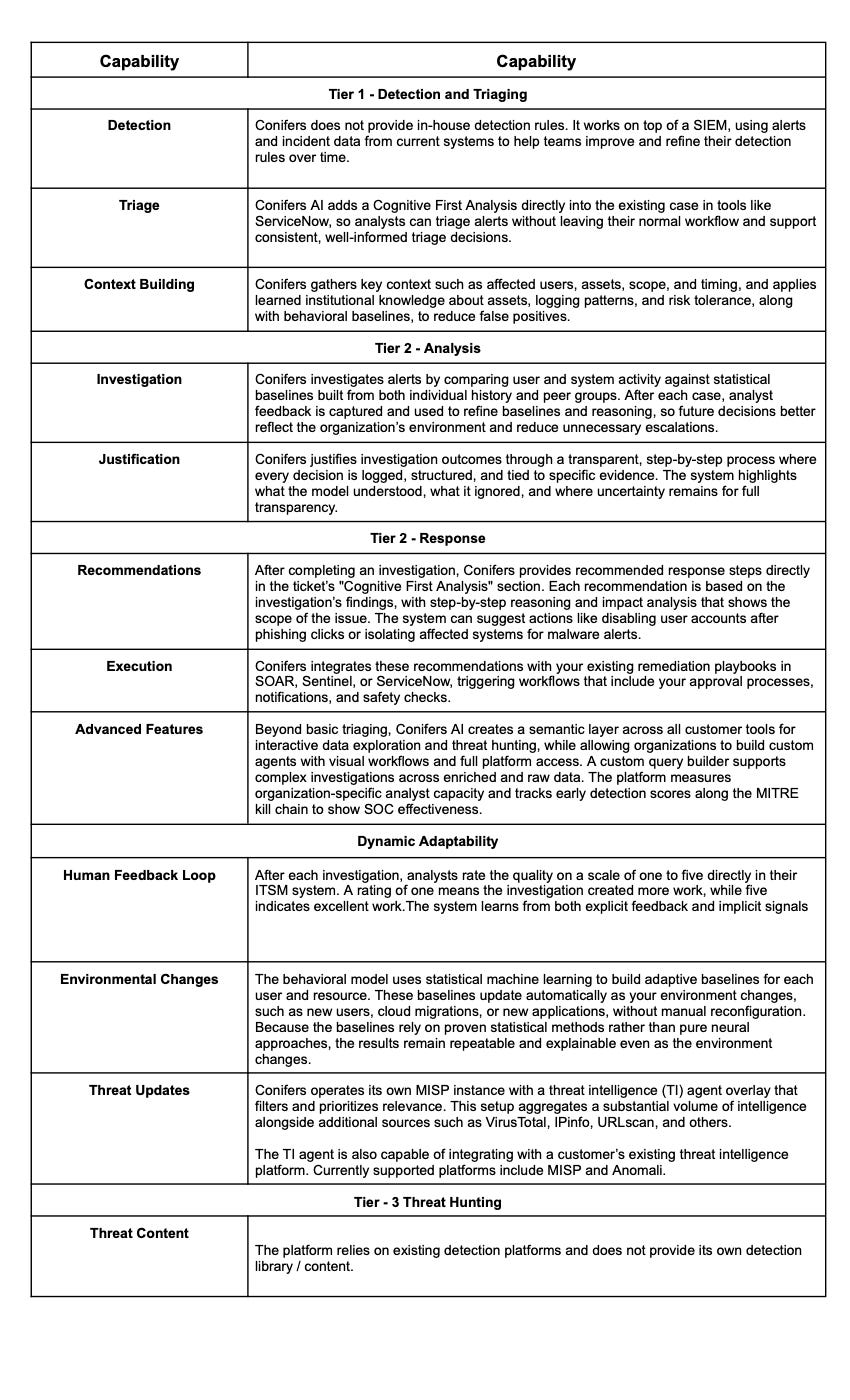
AI Guardrails and Explainability
As we move into the AI SOC world, it’s important to note the different ways vendors address security and privacy concerns. Here’s how Conifers AI protects and maintains privacy of customer information.
Data Privacy and Security:
All AI inference and data processing run entirely on Azure’s infrastructure, with models staged and served within the customer’s selected region. This ensures that data never leaves Microsoft’s controlled environment, providing deterministic data residency and full alignment with Microsoft’s privacy and security standards. Customer data is not used for model training, and all traffic is encrypted both in transit and at rest. For multi-tenant workflows, tenant data is isolated using private endpoints, VNets, and Azure-native access controls such as AAD, RBAC, and Managed Identities.
Explainability:
The investigation workflow is structured into discrete, deterministic steps, each independently validated, executed, and logged, providing full visibility into how decisions are reached. Agents produce step-level reasoning traces that show accessed data, applied transformations, and how outputs were derived. Every finding is linked to underlying logs, alerts, or entities, and results are delivered in a structured, deterministic schema paired with raw data fields. Confidence and coverage signals indicate what the model understood, what was ignored, and where uncertainty exists. This design ensures that every investigation is fully auditable, allowing analysts to trace conclusions back through each step and the supporting evidence.
Analyst Take
Here’s what we see as top 3 strengths that Conifers AI provides
Seamless Integration with Existing Workflows to Avoid Platform Hopping
The platform moves beyond basic alert triage by incorporating impact analysis directly into the investigation workflow by integrating directly into existing ITSM platforms and providing details within tickets in ServiceNow, Splunk SOAR, Sentinel, or Jira. This avoids the need to switch between systems for quick insights. Analysts work in familiar tools, with interactive communications through Teams or Slack, without additional logins or portal switching.
Detection Optimization Focus
Rather than attempting to replace existing detection infrastructure, Conifers AI analyzes response data and historical incidents to refine current detection rules and recommend new ones tailored to the specific environment. This recognizes that many organizations have invested in detection engineering but struggle with tuning effectiveness. The platform’s continuous learning from institutional knowledge helps address the challenge of generic detection rules that generate noise in specific environments.
Knowledge Capture Through Systematic Environmental Learning
Many AI SOC platforms apply generic models across customer environments. Conifers takes an advanced approach by systematically learning what makes each organization unique. The platform captures asset context, behavioral baselines, and risk tolerance through analyst feedback and historical ticket mining. For example: A new employee at one organization might trigger alerts that another organization dismisses as normal
Areas to Watch
Organizations evaluating Conifers should consider the platform’s architectural dependencies. The system does not handle data persistence or operate as a security data pipeline platform, it is designed for customers that want to keep their existing data architecture. It sits on top of existing SIEM infrastructure and queries data from multiple security tools. This design preserves existing investments but means organizations need robust SIEM and data infrastructure underneath. The platform does not provide out of the box detection or threat content, it relies on third party integrations. The “bring-your-own-cloud” deployment dependency on Azure may also be a limiting factor for organizations that want more flexibility.
Conifers focuses on recommendations and orchestration rather than response. The platform doesn’t include native capabilities to directly manipulate firewalls, EDR agents, or identity systems. Instead, it generates recommendations and triggers your existing playbooks that already have those integrations built. If you have a well-implemented SOAR, this positions Conifers as an intelligence and orchestration layer on top of your SOAR capabilities rather than a full replacement.
Daylight
Daylight was founded by Unit 8200 veterans, and former leaders at Torq. They started the company after identifying security services as the main bottleneck in cybersecurity. About half of the 200 billion dollar cybersecurity market is spent on services, yet most still rely on manual and linear workflows. This limits scale, reduces investigation quality, and leads to inconsistent results.
Daylight built an AI native platform designed to work with top security experts from IR and threat hunting backgrounds, which uses multiple specialized AI agents. These agents are coordinated by an AI-driven orchestration layer that manages context sharing, investigation steps, and interaction with human analysts. The agents analyze alerts from existing security tools and combine them with enriched business context from a proprietary knowledge graph and external threat intelligence. The knowledge graph learns each customer environment, enabling context-aware investigations that traditional human-led MDR services would take longer time to match. Daylight delivers Managed Agentic Security Services “MASS” which includes MDR, Threat Hunting and more through an Agentic platform, a global team of security experts.
Company Vision
Daylight’s vision focuses on what the founding team sees as a huge, underserved market that was a bottleneck in cybersecurity for years: not tools, but services. They observed that layering AI onto legacy MDR models would not fix fundamental problems with coverage, investigation depth, or operational scalability. The company built a new operating model where AI agents and senior security experts work as a single integrated system, combining autonomous investigation capabilities with deep customer and threat context. This represents a shift away from the two dominant approaches in the market: legacy MDRs that rely on human-heavy playbook execution, and pure AI SOC tools that aim to remove humans from the loop entirely. Daylight positions themselves between these two models by designing automation that scales with agentic features while maintaining human judgment at critical decision points.
Architecture and Deployment Maturity
Daylight supports a full SaaS deployment model as well as a hybrid model for on-prem assets. Fully on-premises deployments are not supported at this time.
Data Collection and Ingestion Methods
Daylight consumes data from multiple data source types to gather context and detection content:
- SIEM: Detection events and alerts from existing SIEM deployments
- Cloud security platforms: Integration with CNAPP tools like Wiz
- Cloud platforms: Cloud audit logs from AWS, Azure, and GCP.
- EDR platforms: Detection alerts from CrowdStrike and other EDR vendors
- Identity and access: Integration with Okta, identity providers, and ZTNA/SASE solutions.
- Network security: Network logs and traffic analysis
- Threat intelligence: Integration with external threat intelligence sources and support for customer-provided specialized feeds
- ITSM platforms: Integration with JIRA, PagerDuty, and custom ticketing systems
Capabilities
Daylight Security supports detection, triage, investigation and recommendations curated by their business understanding and context from their agentic platform in addition to feedback from in-house security experts.
Agentic SOC / MDR Capability Matrix
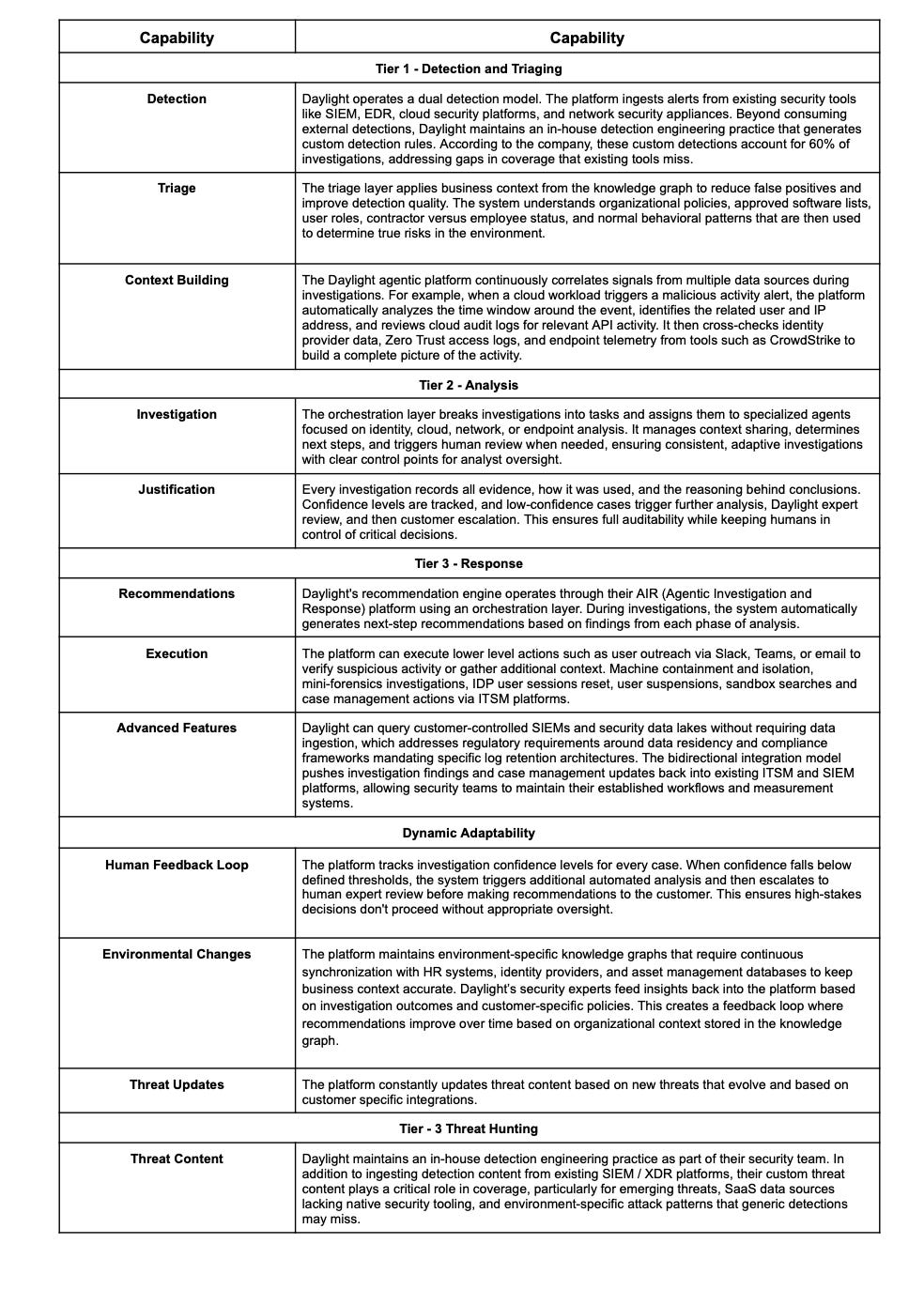
AI Guardrails and Explainability
As we move into the AI SOC world, it’s important to note the different ways vendors address security and privacy concerns. Here’s how Daylight protects and maintains privacy of customer information.
Data Privacy and Security:
Customer data is strictly isolated by the tenant and is not used for training foundation models. All AI interactions with customer data occur within the company’s AWS environment via Amazon Bedrock, with no cross-customer data sharing. Customer-specific knowledge and context are stored in dedicated knowledge bases. The platform supports SOC 2 Type II, ISO 27001, HIPAA certifications.
Explainability:
Daylight provides full transparency for every investigation with additional context that is provided by the security team at Daylight. Every AI action is recorded with full lineage, clear traceability, and supporting evidence to explain how decisions are made. The platform maintains immutable audit logs that capture each inference, action, and automated decision, enabling forensic analysis and compliance review.
Analyst Take
Here’s what we see as top 3 strengths that Daylight Security provides
In-House Threat Detection Expertise
Daylight operates a dedicated detection engineering practice that develops and maintains custom detection rules and threat research. The team actively tracks emerging threats and produces detections for novel attacks before they appear in commercial threat intelligence feeds. Beyond standard detection content, Daylight creates environment-specific detections tailored to each customer’s tool stack, threat profile, and business context, including organizational policies, approved software, and unique attack patterns. This customization allows them to address coverage gaps that standard platforms miss and differentiates them from AI SOC solutions that rely primarily on generic detection logic.
Custom Business Context Integration Through Knowledge Graph
The knowledge graph maintains organizational context,and policy frameworks specific to each customer. This context layer allows investigations to incorporate organizational reality rather than applying uniform analysis logic across all alerts. The system distinguishes between expected behavior for different user populations and understands which alerts are legitimate versus suspicious based on organizational approval status. This contextual awareness reduces false positive rates and improves investigation accuracy for organizations with complex internal structures, multiple business units, or specialized workflows that generic detection logic misinterprets.
Complete Investigative Closure with MASS
Daylight operates as a complete security operations extension rather than just an advisory service. The MASS model delivers 24/7 managed detection and response that handles the full operational lifecycle from initial detection through investigation, response execution, and case closure. In cases where additional context is missing, the alerts are escalated to the customer for decision making in order to avoid false negatives. The platform executes response actions including user outreach via collaboration tools, machine isolation through EDR integrations, mini-forensics investigations using endpoint capabilities, and case management through existing ITSM workflows. This operational ownership means security teams receive closed cases with documented root cause analysis rather than alerts requiring internal follow-up.
Areas to Watch
The depth of customization that sets Daylight apart also raises questions about operational scalability. Maintaining environment-specific knowledge graphs and custom detection logic for each customer requires ongoing synchronization with HR systems, identity providers, policy updates, and organizational changes. It is unclear how this level of customization will be sustained as the customer base grows. Security leaders would need more transparency on the maintenance burden of knowledge graphs, whether detection content can be reused across different tenants or requires development, and how the service model scales operationally. The planned expansion into managed phishing and DLP services further increases scope before the core MDR model demonstrates proven scalability.
Exaforce
Exaforce addresses SOC operations with a platform approach. It brings core capabilities from security data pipeline platforms, such as data preparation, deduplication, normalization, and enrichment, into the ingestion process. That structured data is then passed to its AI SOC engine, that the agents use. The platform delivers task-specific AI agents (called Exabots) for all four primary SOC functions: detection, triage, investigation, and response. Organizations can deploy Exaforce as a self-managed platform or leverage it through MDR (Managed Detection and Response) services. This positions the platform to serve both enterprises with in-house security teams and those seeking fully managed support. They also support saving and querying raw data for long term retention and compliance purposes via their data warehouse.
The founding team saw a shared problem at both ends of the market. Small security teams cannot put modern SOC tools into production because setup takes months and requires specialized engineers they cannot hire fast enough. Large enterprises face growing alert volumes and data sources, forcing them to keep adding analysts just to maintain coverage. This vision is reflected in their recent entry into the AI MDR market, alongside their AI SOC platform.
Voice of the Customer
We were able to connect with a customer of Exaforce who shared their experience with Exaforce with us, as stated below –
Life before Exaforce
Before Exaforce, we struggled with centralizing all of our detections in one place, having “follow the sun” coverage for SOC analysts, and being able to scale investigations into these cases.
Core Use Cases that they use Exaforce for
Exaforce provides 24/7 MDR SOC, Exabot for speedy investigations, Identity insights
What they would like to see on roadmap
Device/Port fingerprinting/blocking, ability to create playbooks for SOC analysts
Company Vision
Exaforce was built on the idea that keeping security operations in step with growing data volumes and an expanding attack surface is becoming too costly to build and manage. Creating a divide between organizations that can afford world-class security and those that cannot. Their vision is to address this through a combined platform and services model that brings high-quality SOC operations to organizations of all sizes. The company has raised over $75 million in Series A funding.
Architecture and Deployment Maturity
Exaforce supports SaaS (Default): Fully-hosted and operated by Exaforce in their cloud environment. For highly-regulated environments or organizations with strict data residency requirements, the Exaforce platform can be deployed in your own cloud infrastructure (customer VPC).
Data Collection and Ingestion Methods
Exaforce doesn’t currently show hundreds of integrations as some other players in the space, however they do have additional depth on their integration types and data types. For example, they integrate with code repositories like Github to gain visibility into code level context for application security related alert detection and triage. They also ingest configuration information in addition to alerts from cloud providers.
- SaaS platforms: SaaS applications such as Google Workspace, others.
- SIEM integrations: Teams with existing SIEM deployments can integrate detection rules and raw log data
- Network data: Network log generation sources and recent integration announcement with Zscaler
- Cloud audit logs: AWS CloudTrail, Azure Activity Logs, and GCP Audit Logs
- Email systems: Phishing detection signals and email threat intelligence
- HRIS systems: For understand organizational context like reporting structure
- Code Repo: Github and the like
- Identity systems: Authentication and access activity from identity providers such as Okta and Entra ID
- EDR platforms: Endpoint detection and response alerts feed into the triage workflow
- Configuration data: Resource configurations from cloud and SaaS environments to understand access controls and security posture
The platform also offers a way to create custom integrations for handling custom applications and complex environments easier.
Capabilities
Exaforce delivers end-to-end automation across the complete security operations lifecycle. The platform aims to enable SOC teams to detect more threats, triage alerts faster at scale, investigate quickly with complete context, and respond with confidence.
Agentic SOC / MDR Capability Matrix
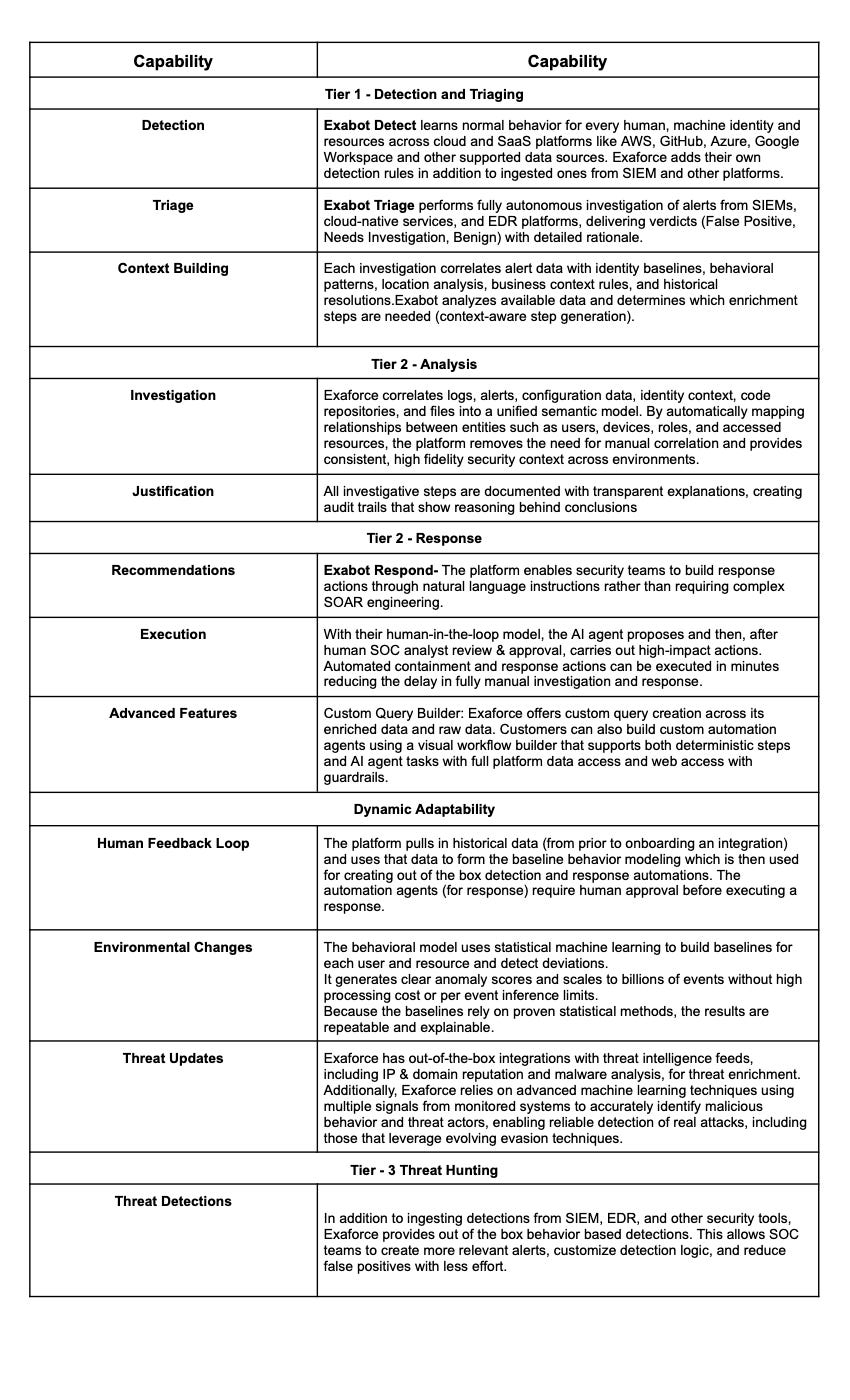
AI Guardrails and Explainability
As we move into the AI SOC world, it’s important to note the different ways vendors address security and privacy concerns. Here’s how Exaforce protects and maintains privacy of customer information.
Data Privacy and Security: Each customer is deployed in their own cloud account with their own data warehouse. Any data sent to frontier models is bound by zero retention policy. The frontier model providers are obligated to never store or use this data for their own training purposes. Customer-specific data trains models specific to that customer’s environment. Training data across customers is never customer-specific. The company maintains HITRUST, SOC 2 Type I and II, ISO 27001, PCI DSS, HIPAA, GDPR, and USDP certifications.
Explainability: All tasks performed by the agent is documented, including why it chose to perform those tasks, for complete transparency and auditability. The documentation includes task descriptions and execution time. Every alert comes with natural language explanations of why it fired and why the result is what it is. Exabot acts as a built-in AI cloud expert that translates complex security events into understandable insights. The forensic evidence behind every outcome (the events, baselines, configurations, and other data) is clearly presented
Analyst Take
Here’s what we see as top 3 strengths that Exaforce provides
Deep Integrations with Code-to-Cloud Coverage
Exaforce goes beyond typical SOAR API integrations by pulling events, configs, identity data, and code artifacts. The GitHub integration includes SBOM API access, enabling searches for compromised packages and detection of anomalous repo access or secrets exposure through GitHub Actions. These detections work out of the box without configuration. HRIS integration provides identity context like reporting structures, and the platform immediately flags suspicious behavior (like red team activity) without prior setup.
Multi-Model AI with Pre-Investigation and Contextual Baselining
Rather than just feeding raw logs into an LLM, Exaforce pre-processes data to build semantic connections, behavioral baselines, and peer comparisons. The AI operates like a Tier 3 analyst, asking and answering its own questions based on the data schema. For example, it prevents false positives from new hires by comparing behavior to peer groups, not just individual history. The platform achieves higher confidence score on manually triaged alerts because the knowledge model has deep, pre-investigated context before making triage decisions.
Intelligent Data Architecture That Solves Scale and Cost Problems
Exaforce addresses the fundamental challenge of cloud log volume through a two-tier approach: 90 days of processed, security-specific data in an in-memory database for fast queries and detections, with full raw data in cold storage. This eliminates the need for tools like Security Data Pipeline Platforms because filtering and downsampling happen internally before loading into memory. Security teams get fast investigations and detections without expensive data warehouse queries, and they retain all raw data for compliance and historical analysis.
Areas to Watch
As organizations evaluate the platform, they should assess integration breadth compared to established solutions with hundreds of pre-built connectors. The platform covers critical cloud and SaaS services (AWS, GCP, Azure, Okta, Google Workspace, GitHub, Atlassian), though the total count of out-of-the-box integrations is not specified. Security leaders should validate coverage for their specific technology stack, particularly for legacy on-premises systems and niche SaaS applications. The platform’s strength in cloud and SaaS security positions it well for modern environments, though organizations with significant on-premises infrastructure should evaluate how comprehensively the platform addresses traditional network and endpoint security operations beyond alert triage from existing tools.
Swimlane
Swimlane approaches AI SOC through a foundation-first strategy, focusing on Agentic AI architecture with connectors, hyperautomation engine, and automation applications (playbooks, case management, dashboards, reports and the like) layered with Agent builders and specialized deep agents that are clusters of interconnected AI agents working to replicate security functions. These agents are made to intercommunicate and perform complex, multi-step and specialized tasks in SOC workflows. The note about intercommunication strikes as important to us because of the “context” stitching that it allows. Purpose-built agents are helpful when they are also accountable and taking into account the actions from other specialized agents in order to provide a complete end-to-end security posture.
The Swimlane AI SOC autonomously builds investigation plans, executes playbooks, and creates specialized skills-based agents focused on specific tasks like detection engineering, incident response, threat intelligence management, and artifact analysis. Deep agents within the platform can ingest alerts, build investigation plans, and execute security investigations to determine a verdict for both known and unknown alerts. Swimlane’s AI SOC can also build and edit playbooks from a high level natural language prompt. Additionally, AI SOC builds a remediation plan for security teams to review and approve. These agents leverage historical telemetry, past analyst notes, and institutional knowledge to correlate similar instances and provide confidence scoring that customers can measure against human analyst decisions before trusting AI verdicts.
Voice of the Customer
We were able to get in touch with a customer of Swimlane and get his direct feedback as stated below –
Life before Swimlane
Before Swimlane, we were a Palo Alto shop. Price relative to value, shortcomings in vendor relationships, and ongoing technical issues on the XSOAR platform were the primary reasons we chose to partner with Swimlane for AI automation. Swimlane quickly demonstrated speed, technical capability, and an architectural vision that won out over what we knew would be a massive expansion of unified global services.
Core use cases that they use Swimlane for
As a global service provider, we needed to centralize multi-region, multi-tenant analyst workloads into a single workbench. We are now layering AI alongside our analysts for a full AI SOC experience, while keeping our team in the loop for oversight and guidance.
This unified AI SOC workbench enables us to offer unified services beyond our standard SOC-focused offerings, leveraging Swimlane Business Continuity Management and Vulnerability Response Management from a central management console.
What they would like to see on roadmap
- Quick scalability with integration of AI SOC decisions and workflows across all service offerings like vulnerability management.
- Multi-model architecture, including internally-owned/bring your own models/LLMs
- Expanded RBAC for data control, builder control, and AI review, extending to multi-model capabilities if possible
Company Vision
The company’s vision centers on delivering AI intelligence at the high-throughput, low-latency, cost-effective scale that only mature automation can provide. This approach aims to improve key security operations metrics including reducing human escalations, decreasing investigation times, improving false positive rates, enhancing verdict accuracy, and maintaining low hallucination rates. The company is not afraid to hold back innovation capacity to iterate quickly based on customer feedback and capitalize on advances across the AI stack as the definition of AI SOC continues to evolve.
Architecture and Deployment Maturity
Swimlane supports SaaS, Private Cloud deployments across all IaaS providers including GovCloud and Fed IaaS, and fully on-premises installations on both hardware and virtual machines.
Data Collection and Ingestion Methods
The platform provides a wide breadth of integrations with third-party actions across security tools, IT systems, communications platforms, and other enterprise applications.
- Cloud Security & Cloud Logs: Security telemetry and events from cloud providers and services such as AWS, Azure AD, Google workspace etc
- Network Security: Sources that provide network telemetry, firewall logs, and threat blocking.
- Endpoint & EDR / Threat Detection Platforms: Endpoint detection, response, and threat detection feeds.
- Threat Intelligence & CTI Sources: Threat and indicators enrichment sources.
- Email Security: Sources related to email monitoring, phishing, and messaging security.
- Compliance, Audit and Governance platforms
Capabilities
Swimlane’s AI SOC capabilities center on Hero AI, which provides specialized deep agents and extensible skills-based agents that security teams can customize for domain-specific tasks.
Agentic SOC Capability Matrix
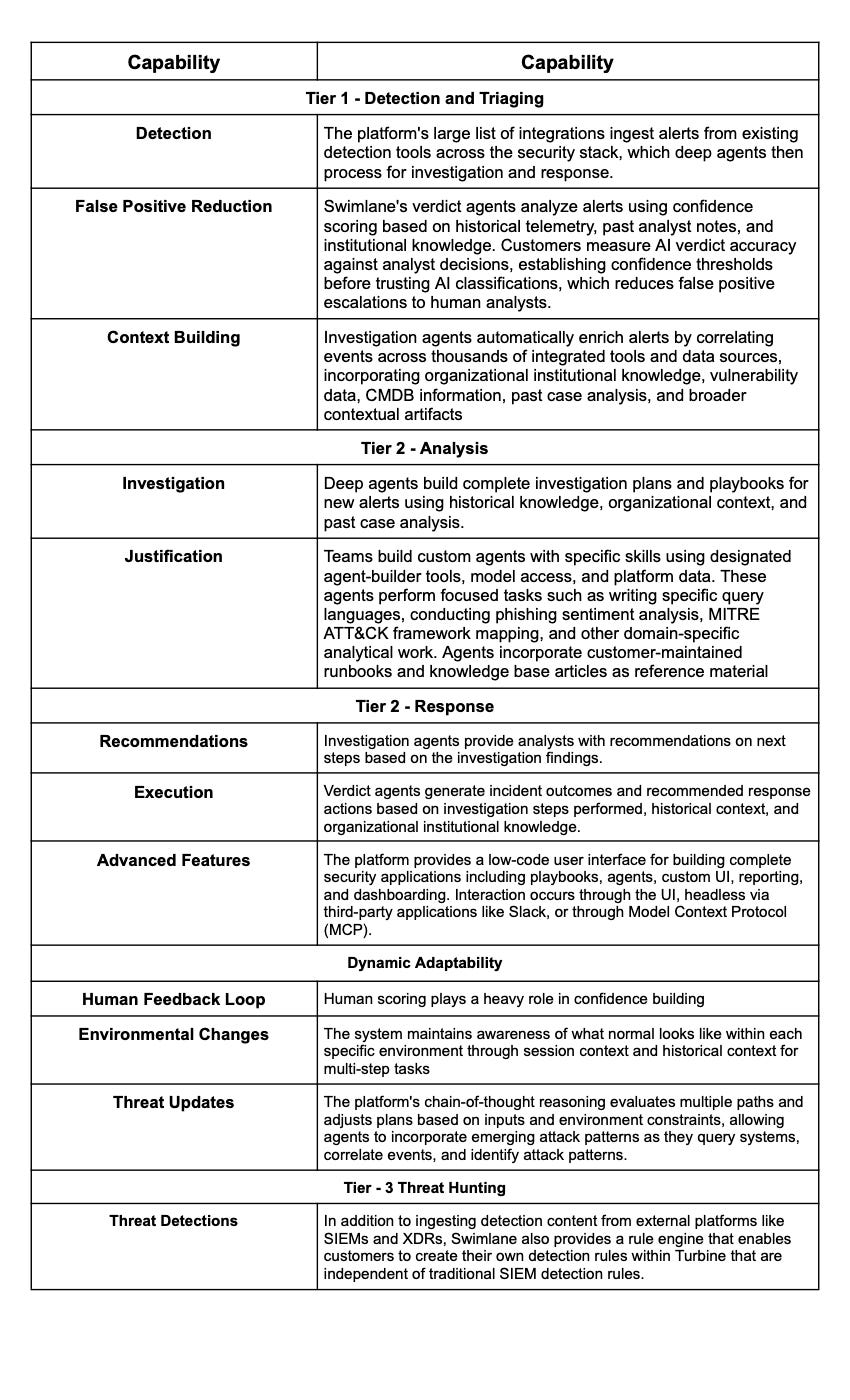
AI Guardrails and Explainability
Swimlane maintains strict data isolation and inherits security postures directly from cloud and AI partners including AWS, Amazon Bedrock, and Anthropic.
Data Privacy and Security
Customer data is not used to train any AI models as a fundamental policy. All customer data remains within dedicated AWS instances with AWS security controls for encryption and access management applied. The platform directly inherits data privacy and security guarantees from Amazon Bedrock and Anthropic, where data passed for inference is not used to improve or train foundational models and is processed and discarded after use. Swimlane holds AI-specific security certifications including ISO 42001, along with ISO 27001, GDPR, CMMC, and CSA STAR.
Explainability and Transparency
AI integrates as an assistive layer within the deterministic automation framework. AI-generated suggestions and actions execute through Swimlane Turbine playbooks that generate execution runs for every automation action, providing full explainability of what action was taken and why it was suggested. For all critical actions, the AI agent serves in an assistive role where proposed actions require explicit review and approval by an analyst. This human-in-the-loop approach ensures transparency and human oversight as the final point of explainability. All actions maintain complete audit trails.
Analyst Take:
Here are the top three strengths Swimlane provides:
Proven Automation Foundation for Agentic Operations
Swimlane differentiates through its decade-long engineering investment in the core automation fabric that agentic operations require to function effectively at scale. The platform provides 487 connectors (according to their public marketplace) and many third-party actions, and an autoscaling automation engine that has been adopted by Fortune 500 and Global 2000 companies. This foundation addresses the reality that AI agents require massive normalized data ingestion capacity and high-velocity action execution that cannot be achieved without mature underlying infrastructure. Competitors may offer compelling AI features but Swimlane brings its experience action engine and data ingestion infrastructure to help larger enterprises and deployments
Deployment Flexibility for Regulated Environments
The platform supports SaaS, private cloud across all major IaaS providers including GovCloud and Fed IaaS, and fully on-premises deployments on hardware and virtual machines. This flexibility addresses compliance and security requirements for regulated industries and government customers who cannot use SaaS-only offerings. The ability to deploy into customer environments while maintaining AI capabilities through connection to Fed IaaS expands the addressable market beyond what SaaS-only competitors can reach.
Deterministic Execution Guardrails
Swimlane layers generative AI, deep agents, and specialized skills agents within the guardrails of predictable automation. This architectural decision ensures that AI-driven actions execute reliably and immediately through battle-tested playbooks rather than depending on AI-onlynative execution environments that lack production maturity. The approach provides measurable outcomes through leading case management, self-service dashboards, and reporting that visualizes ROI and performance of the agentic workforce. The human-in-the-loop model for critical actions and complete audit logging addresses the trust and compliance concerns that security leaders have regarding AI-driven decisions.
Areas to Watch
Swimlane positions itself as an agentic AI automation provider across every security function; however, it may still be known predominantly for the SOAR category rather than the AI-SOC category due to its historical positioning. The emphasis on proven automation and deterministic guardrails is a strength for enterprises that require production reliability and cost-effective solutions. However, given its previous dominance in the SOAR category, there may be a perception that AI-SOC capabilities are an add-on architecture, as opposed to vendors that have led with AI-SOC messaging from the outset, even though the platform itself is built with AI-native infrastructure in mind. Additionally, while the platform provides extensive integration breadth, competitors are investing in direct analytical capabilities such as cross-system / storage queries, cost-efficient log warehousing for long-term retention, and mature behavioral analytics with rapid baseline formation. The consideration in evaluating Swimlane is whether the proven automation foundation and deployment flexibility align with the strategy for AI-driven operations versus the agentic-only capabilities that newer AI-SOC platforms provide.
The Reality of “Agentic AI” From a Practitioners Perspective
When evaluating AI SOC and AI MDR platforms, this is what security leaders should take into account. Focusing solely on feature lists or detection speeds is not enough. Security leaders need to test these platforms with their own data, understand how the AI makes decisions and identify which vendors solve specific problems better than others.
How to Test and Compare
Effective evaluation requires realism. Buyers should test AI SOC and AI MDR offerings using their own data, even if it is only in limited scope. The focus should be on decision quality, rather than speed alone. How well does the system understand environment specific context? How clearly does it explain reasoning? Where does it fetch additional information? How gracefully does it escalate uncertainty to humans?
It is also important to understand where vendors specialize. Some excel at telemetry aggregation from security technologies, or even SIEMs. Others focus on reasoning, prioritization, and responses SOCs should take. Others integrate deeply with cloud and identity platforms, while others emphasize analyst expertise. Understanding these strengths help align solutions with actual needs, combined with program maturity, rather than chasing broad coverage.
Constraints that Shape Every Decision
AI does not remove fundamental constraints of security programs. People are still required to exercise judgement and accountability. Processes must evolve to incorporate AI driven insights without bypassing governance. Technology must be integrated cleanly to avoid fragmented context. Business priorities must remain the lens through which risk is evaluated. Organizations that succeed are those that treat AI as an operating model decision rather than a tooling upgrade. When applied thoughtfully, AI does not just make security operations faster, it makes them more deliberate, resilient, and aligned with how modern organizations actually function.
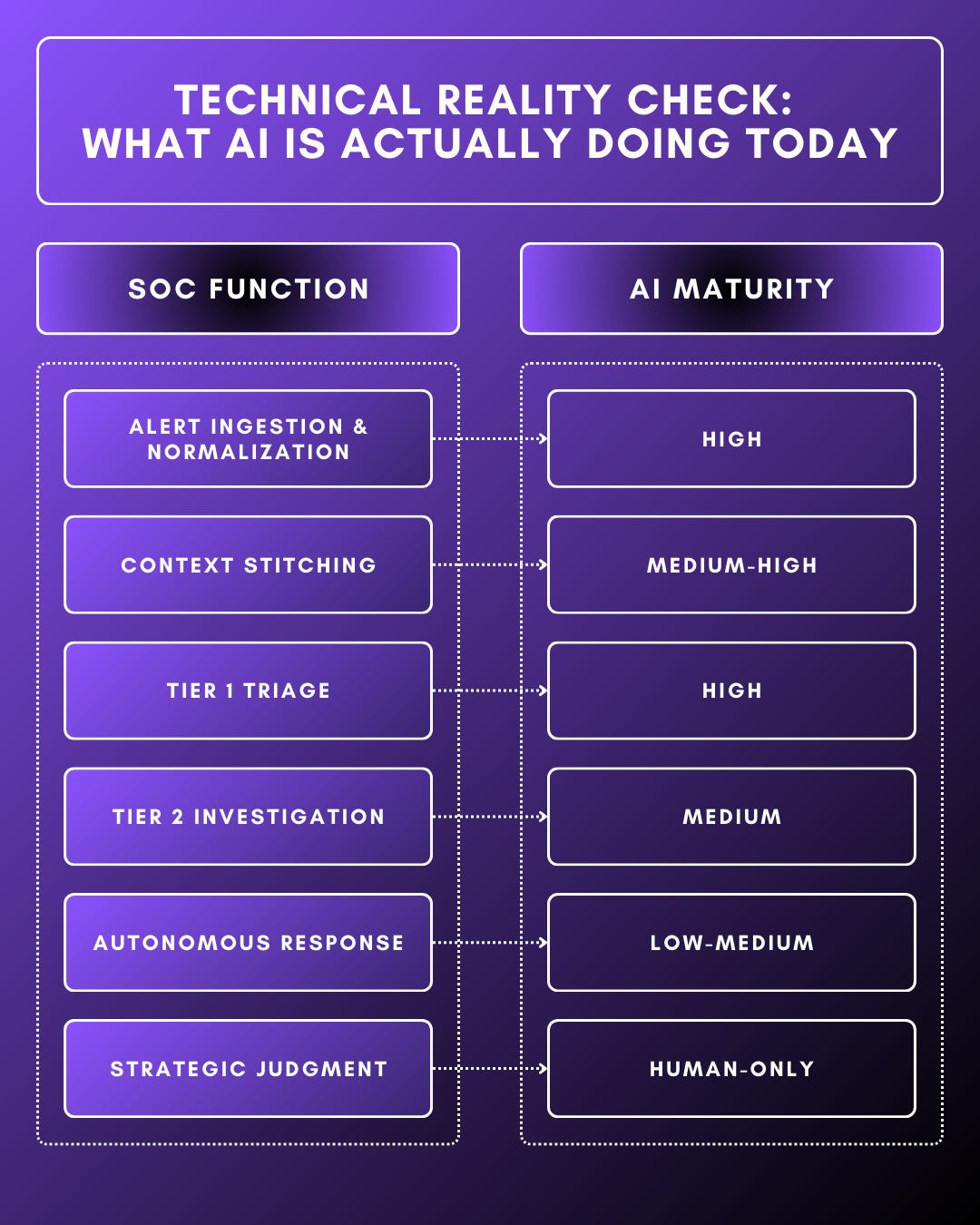
The Future of MDR
AISOC-powered MDR is rapidly becoming the reference model for scalable, consistent, and cost-effective security operations. The long-term winners in this market will not be defined by claims of full autonomy, but by their ability to deliver high-quality outcomes with clear accountability, transparent decision-making, and measurable improvements in detection and response.
For organizations evaluating AISOC-driven MDR offerings, the critical questions are no longer whether AI is used, but how it is governed: how investigations are explained, where autonomy is permitted, how uncertainty is escalated, and how responsibility for failure is contractually and operationally defined. The future of MDR will belong to providers that successfully blend AI-driven automation with human oversight, delivering security outcomes that scale without sacrificing trust.
“Ideal” Mapping AI SOC and AI MDR Across Maturity Stages
In early stage, or resource constrained organizations, the primary challenge is coverage. Teams are small, on-call rotations are thin, and building a full SOC is often very unrealistic. In this stage, AI augmented MDR offerings make the most sense. They combine AI driven analysis with human expertise, providing 24/7 coverage, and a structured escalation process without requiring significant internal investments. The value here is speed to capability, risk reduction, and lower liabilities, not customization.
As organizations move into a growth, or mid-stage phase, the limitations of outsourced models begin to surface. Internal teams want more visibility, more control, and deeper understanding of their environment. This is where you start to see the hybrid models emerge. AI powered SOC capabilities are introduced internally to handle enrichment, triage, and prioritization, while MDR may still provide after hours coverage or specialized support. The organization begins to retain more institutional knowledge while still leveraging external scale.
In mature security programs, the balance often shifts decisively toward an internal SOC model. Teams have the expertise to interpret nuanced signals and the desire to embed security deeply into engineering and operations. AI becomes a force multiplier rather than a substitute. MDRs may still play a role for surge capacity, additional services, or specialized threat intelligence, but the core decision making and learning loops live inside the organization. At this stage, the value of AI lies in amplifying expertise and improving decision quality across the entire lifecycle.
A Debate That Resolves Through Segmentation
This debate is unlikely to end in convergence. It resolves through segmentation. Agentic SOC platforms will continue to gain traction inside organizations that are willing and able to retain accountability, governance overhead, and operational risk. AI-first MDR services will expand where responsibility transfer, consistency, and operational simplicity dominate purchasing decisions.
The mistake is to treat these models as competitors for the same buyer in the same context. They are not. They represent two structurally different responses to the same underlying pressure: how to operate security functions in a world where human-led SOCs no longer scale cleanly. AI does not collapse the insource-versus-outsource distinction. It sharpens it by making the cost of error more explicit.
A telling market signal reinforces this conclusion. Several vendors that began as agentic SOC platforms are increasingly offering MDR-style delivery, either directly or through partners.
Exaforce has moved beyond pure tooling into outcome-oriented services. 7AI has been deployed through managed security operations partners. And platforms like Torq, while historically rooted in orchestration, are increasingly oriented toward enabling managed service delivery alongside internal use cases. This pattern is not incidental; it reflects where adoption friction actually sits.
This shift does not contradict the platform thesis, rather, it validates it. Autonomy is easier to buy when it is bundled with accountability. Services provide a faster path to trust, clearer time-to-value, and tighter operational feedback loops, all of which are critical for agentic systems to improve in production.
At the same time, this convergence introduces real tension. Moving into MDR creates channel conflict, operational complexity, and a higher bar for reliability. Not every platform vendor will execute this extension successfully. But as a directional signal, it is unmistakable. When even software-first vendors feel compelled to wrap their technology in services, the market is sending a clear message: agentic capability alone is not enough. Outcomes, ownership, and accountability are what ultimately drive adoption.
Conclusion
AI is reshaping security operations, but it is not redefining human accountability. Across maturity stages, the adoption of agentic SOC platforms or AI-first MDR services is driven less by the raw capabilities of AI and more by who owns the risk, how governance is maintained, and what operational constraints exist. Early-stage or resourced constrained organizations benefit most from AI-augmented MDR services that transfer accountability while providing 24/7 coverage. Growth-stage organizations often embrace hybrid models that balance internal AI SOC capabilities with selective external support, retaining knowledge while leveraging scale. Mature security programs internalize AI to amplify expertise, accelerate investigations, and improve decision quality across the SOC lifecycle.
AI is not an elixir to solve everything, but when thoughtfully applied, it transforms the SOC from a reactive operations center into a strategic decision engine, delivering speed, scale, and insight without sacrificing accountability. The choice between AI SOC and AI MDR is less about technology and more about responsibility. Nonetheless, the right decision will shape the effectiveness, efficiency, and resilience of security operations for years to come.
Why Traditional MDR Struggles to Scale
Traditional MDR exists because running a 24/7 SOC is difficult, expensive, and talent constrained. Outsourcing detection and response has been the most practical way for many organizations to achieve coverage and reduce operational burden. The market’s size confirms this demand.
At the same time, the human-led delivery model creates hard limits. MDR services still rely on analysts to triage alerts, investigate incidents, and make escalation decisions across many customer environments. While tooling and automation have improved efficiency, they have not changed the core economics. Growth still requires more people, especially for investigation and continuous coverage.
This leads to uneven outcomes. Service quality often depends on which analysts are assigned, not on the platform itself. As providers scale, maintaining consistent depth and speed becomes harder. Most organizations receive protection that works in normal conditions but degrades under pressure, high alert volume, or complex attacks.
How AI-First MDR Changes the Model
AI-first MDR emerges as a response to these limits. Instead of adding automation around analysts, investigation and initial response are handled by systems, with humans focused on oversight, uncertainty, and approval. The unit of scale shifts from analyst hours to machine-led investigations.
The key difference is how quality behaves at scale. In human-led models, quality is limited by fatigue, turnover, and staffing ratios. In AI-driven models, quality can improve as systems process more incidents and environments. Correlation improves, context deepens, and investigations become more consistent over time.
Where this model works, false positives drop, investigations are more thorough, and response is faster and more reliable. Economic benefits follow, but they are secondary. Lower cost and better margins result from better delivery, not the other way around. Where automation fails to handle real-world complexity, AI-first MDR collapses back into human-heavy workflows and loses its advantage.
Accountability Defines Adoption
As AI takes on more decision-making, the central question becomes ownership of failure. This drives a clear split in how organizations adopt AI SOC capabilities.
Internal AI SOC platforms are used to support in-house teams. Automation is gated, explainability is required, and humans retain decision authority for high-impact actions. These platforms improve productivity but do not replace accountability. Adoption is cautious and shaped by governance tolerance.
AI-first MDR services deliver outcomes, not tools. Responsibility for investigation and response is transferred to the provider. This model appeals to organizations that value simplicity, consistency, and reduced operational risk, especially where staffing and coverage are hard to maintain. The future of MDR will be defined by models that combine scalable automation with clear ownership, transparent decisions, and trust in how failures are handled.
Ultimately, the strategic value of AI lies in its ability to elevate human judgement, reduce toil, and improve consistency, not to replace the workforce. Whether deployed as a platform or as a service, AI must operate transparently, with explainable reasoning and clear escalation paths, so that organizations retain oversight while compounding operational learning over time. Leaders who understand this distinction and align AI adoption with organizational maturity, risk tolerance, and governance capacity; position their security operations to scale sustainably, respond with precision, and maintain resilience in an increasingly complex threat landscape.